A Virtual "Sansara": An Overview of Second Life in the Modern Day
By Misha for GDD 596: Digital Heritage: Preservation of Gaming Artifacts with Professor Borman
By Misha for GDD 596: Digital Heritage: Preservation of Gaming Artifacts with Professor Borman
Introduction
One of the most enduring and enthralling premises throughout the science fiction genre has been the ability to transport oneself into a virtual world, and live in an alternate reality to our own. What was once exemplified in media like Tron and Ready Player One has been made a reality throughout the years, and evolved into an expansive genre of virtual experiences both for business and pleasure. All of that being said, one virtual world has reigned supreme and set the stage for nearly all others that have followed; That being Second Life. Over the last 22 years, Second Life has endured, developed, and flourished as a game that respects user creativity and self-guidance. Because of this, Second Life can be understood as an irreplaceable cultural and historical artifact, both to the world of gaming and to what it means to socialize and interact in our even-changing digital age.
An Early History of Metaverses
Second Life (SL) was officially released to the public in 2003, although this was following almost 10 years of conceptualization and development by its founder, Philip Rosedale (Linden Lab, 2020). Rosedale and his company, Linden Lab, began development of their own 3D virtual world in 1999 as a means to play-test their proprietary haptic hardware at the time. However, they were far from the first developers to conceive of such a product; 1995 saw the development and release of virtual reality programs like Active Worlds and Worlds Chat (Gao et al., 2024, pg. 2), programs that were gaining popularity amongst both hobbyists and the general public as some of the earliest true "metaverses". The term "metaverse" was first introduced in the 1992 science fiction novel Snow Crash, and these earliest, turn-of-the-century iterations, were limited in scope to the realms of gaming and socializing (Gao et al., 2024, pg. 535). While the term has expanded to include education, business, and other industries in the last decade, Second Life's early emphasis on user-created content making up nearly all assets present within this virtual world quickly became what set it apart from all other comparable games at the time. Rosedale has described these serendipitous beginnings as, "It started out as a small iSLand with just some trees on it. And as residents came in, they began buying and developing that space... They started building the content, like glasses or clothes, or tables or chairs, or guns or cars. We didn't build any of that. We simply built a technology platform" (Spingarn-Koff, 2010). Here is where one of Second Life's most recognizable branding strategies was developed from, that it isn't a game at all; As the software functions as both a 3D creation tool and avatar-based chatroom client, there is no ultimate goal, as is so common to most recognizable video games. This has not stopped many users (including myself) from describing SL as a game though, as contemporary software with similar features such as The Sims or MMOs like World of Warcraft are absolutely understood as games, and to understand Second Life as such pushes the limits of what preconceived notions about creativity and productivity a game can entail. An excellent example can be seen in Figure One, where the first developed region of Second Life's virtual grid titled "Da Boom" is still accessible today in the form of a joint playground/historical monument. Play and gaming have been intrinsic to Second Life since the very beginning, a particular sense of whimsy in the digital world that has characterized the "Y2K" era it came out of that saw virtual possibilities as endless.
Figure 1: Visiting "Da Boom" Today
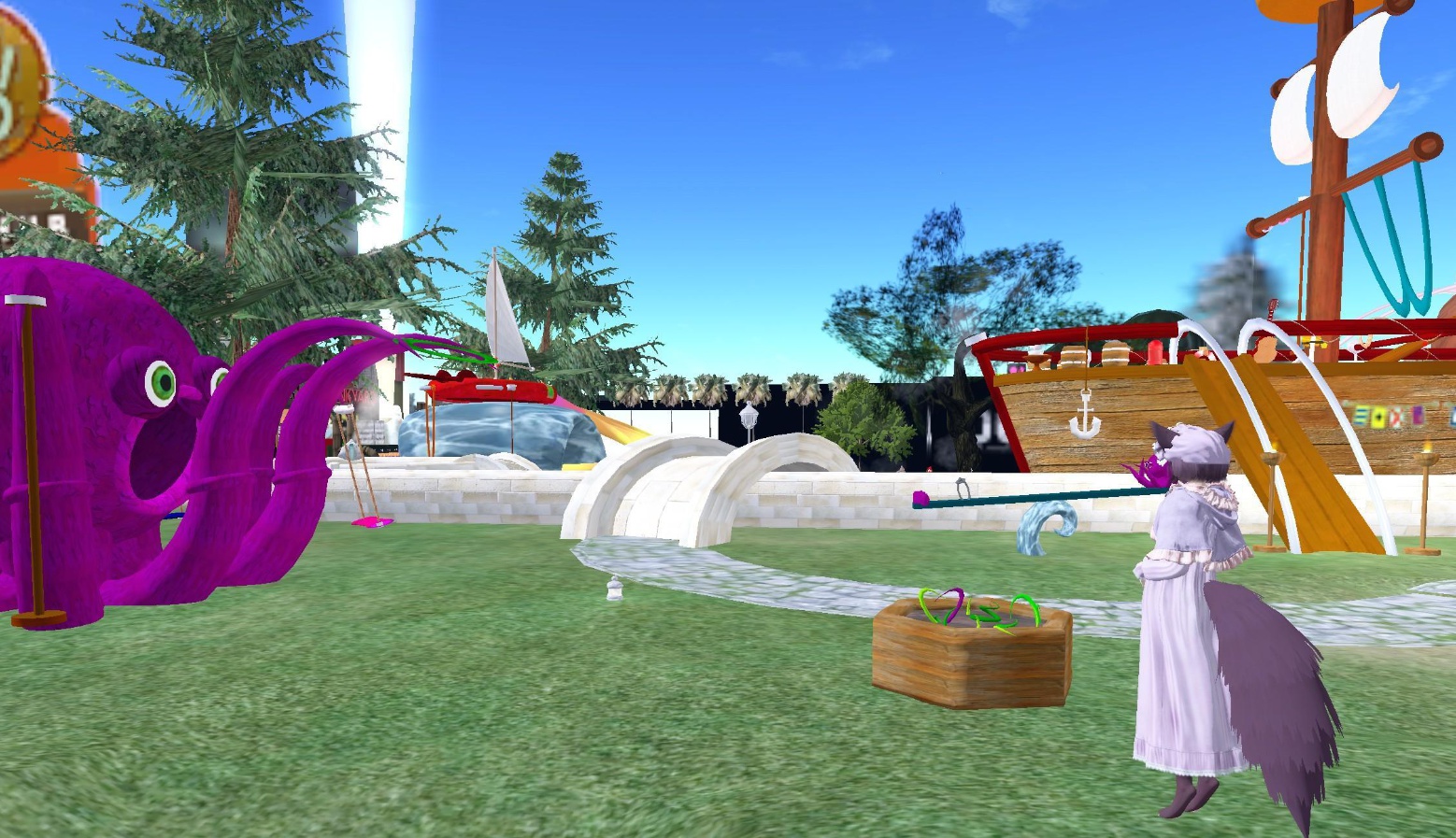
Note. Screenshot taken by the author in September 2025, and features the author's SL avatar.
A Culture of Creativity by the People, for the People
Following this conceptual ideal, to describe all of the multitudes of cultures and identities present within Second Life would be an impossible task. SL's avatar customization is second to none, with users having created 3D assets both with the in-game tools and external software like Blender and selling them for a modest price on the user-run Marketplace for anyone to tinker with and make their most ideal representation. However, it is difficult to say that all avatars in Second Life are meant to be some facet of the person accessing the virtual world through them; For many, the avatar is absolutely a tool for roleplaying a completely different life, in a completely different world from their real one. This can be a shift as minute as career choice, to something farther along like gender presentation, to ones as extreme as roleplaying as a completely different, nonhuman species. Figure 2 demonstrates just a few of the avatars I myself have put together over the years, all of which come with their own features to immerse a given user further in the nonhuman experience.
Figure 2: A Selection of Avatars
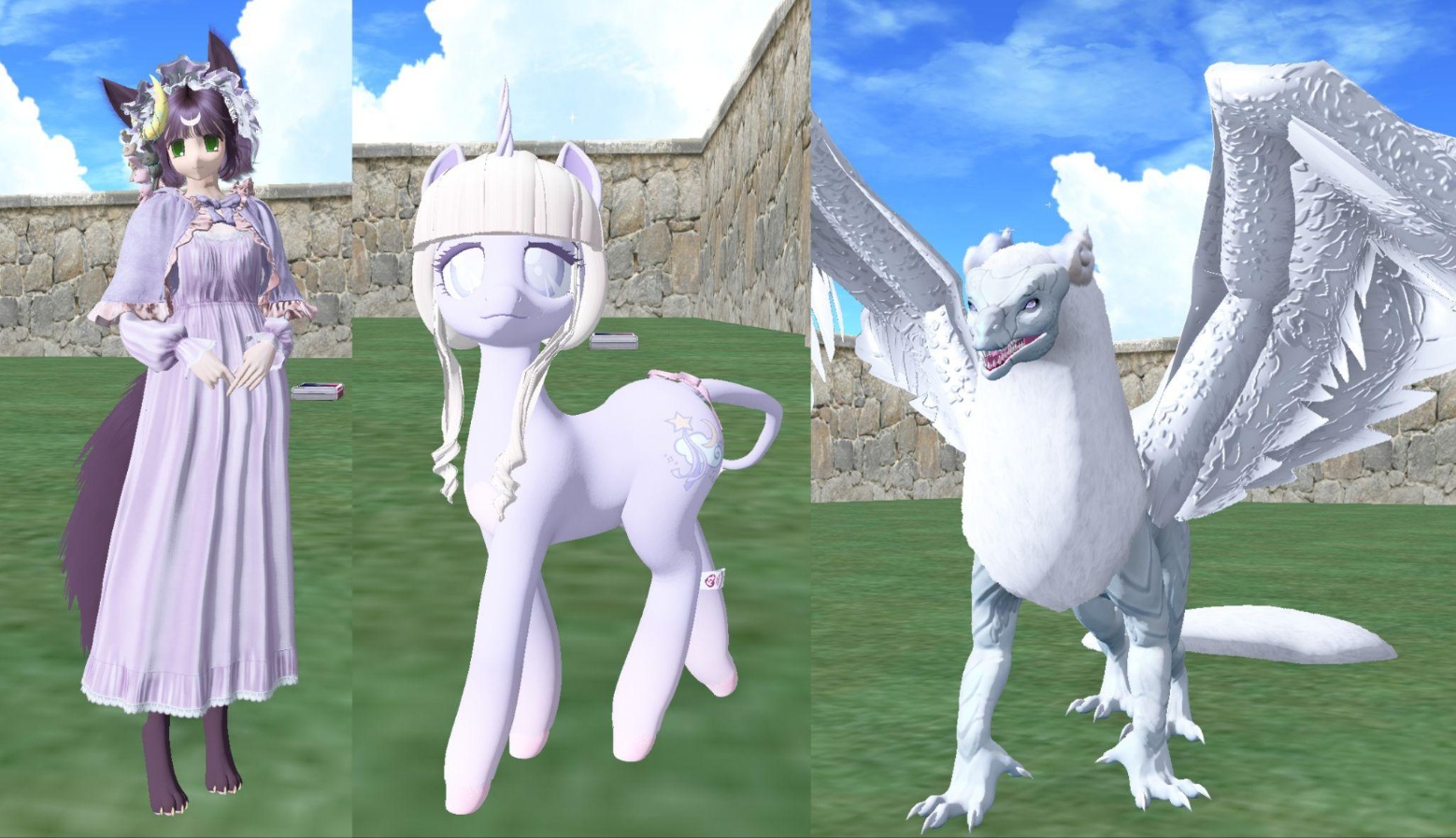
Note. Screenshots taken and spliced together by the author. The leftmost avatar is used the most.
Anthropologist Tom Boellstorff acknowledged these seemingly immutable existences as actually being harmonious, explaining, "Their online lives could make their actual-world self more 'real,' in that it could become closer to what they understood to be their true selfhood, unencumbered by social constraints or the particularities of physical embodiment" (Boellstorff, 2008, pg. 121). Speaking firsthand, as someone who is queer and autistic, the freedom and acceptance afforded by Second Life's platform for self-expression and accessible socializing has been a major factor in its staying power for many residents over two decades after launch. Many communities that have stood the test of time within the game were founded and are maintained by users that are part of various marginalized communities, who have found strength in numbers by connecting those who are unfairly judged in the real world to opportunities to play, explore, and grow without those constraints. It is very common that, "When a user discloses that he or she has a disability, others do not seem to react as they would in the real world because the disability does not exist in SL" (Stewart et al., 2010, pg. 256). This absolutely was true 15 years ago and still rings true, and has always been a major draw to the user-driven nature of Second Life. In fact, such self-governance isn't just the preference of the userbase, but is baked into the very design philosophy that initially led Second Life's development. Rosedale has discussed such a laissez-faire approach to governing a virtual world as, "The virtual world can only be successful if it is largely ungoverned, and I think the community often wants us to intervene at times where it is inappropriate... There's often a call for governance that would be in itself so stifling, to restrict the growth of the whole community. But there are frustrating moments where you really want that to happen." (Spingarn-Koff, 2010). This statement holds true for the most part to this day, where Linden Lab only intervenes when their Terms of Service is broken; leaving the majority of in-game moderation to individual communities and sellers when issues come forth. This has created a niche for further identity development within the community, not just as the person they wish to represent, but for careers like bouncers, real-estate agents, business owners, and financiers to develop, among countless others.
Where Art and Technology Intertwine
As Second Life has developed in the last 20 years to provide users with a more up-to-date engine to suit their needs, so too have users followed suit and evolved their visual style to go along with it. In the absolute beginning, users were limited to the native creation tools present to Second Life's engine; These mostly being uploading their own textures to make clothing that snugly fit the default body model, and the use of 3D "primitives" or "prims" shapes as building blocks. Users during this era would have to get creative when it came to avatar creation, and would often combine these 2D and 3D assets; For example, using a textured cone-shaped prim alongside textured skintight pants to simulate bell-bottomed jeans, like in Figure 3.
Figure 3: An Early Example Product
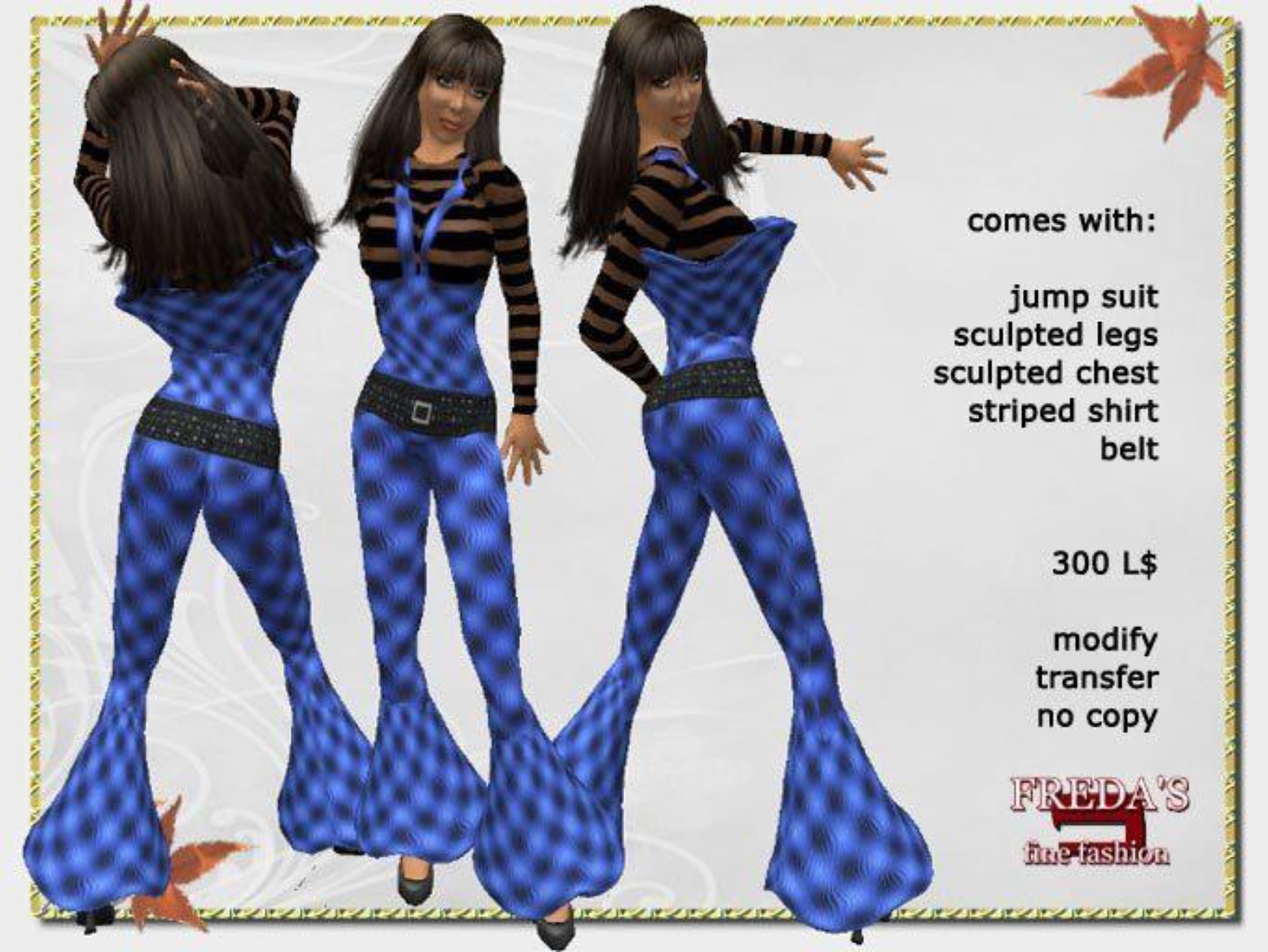
Note. Advertisement for the store titled 'Freda - Fashion and Accessories' on SL's marketplace. The 'sculpted' assets are made of prims, and the 'modify' and 'transfer' labels mean the user can edit and pass around the product in-game; 'no copy' means there is a single copy per purchase. The price, 300 $L, is in the in-game currency of Linden Dollars; approximately equivalent to $2.67 USD in September 2025.
In 2011, Second Life began providing support for 3D mesh to be imported into the game (Linden Lab, 2020), allowing for 3D artists of all skill levels to bring vastly more detailed creations into the game world. This has also, though, been a point of contention for many users; Between SL's live service model providing access to over 20 years worth of creations, and the preponderance for unskilled 3D modelers to upload vastly unoptimized creations, the game can be infamously laggy for users even on a modern, top-of-the-line computer. Seemingly anticipating this, Second Life had made its client open source in 2007, which paved the way for much more optimized, 3rd-party clients like Firestorm Viewer and Alchemy Viewer to be developed. These softwares- maintained by Second Life users rather than Linden Lab themselves- contain far more features for aesthetic customization, including a built-in animation manager and different lighting effects to enhance the appearance of the game. The next big breakthrough by Linden Lab came in 2015, when Project Bento was introduced as an extension to the default avatar skeleton (Linden Lab, 2020). With Project Bento's release, Second Life was clawing into the modern era, allowing more precise articulation of avatar models in terms of hand movement and motion capture technology. The most recent major shift has been to the introduction of PBR textures in 2024, allowing for some staggering visuals to be crafted, as seen in Figure 4. With each technological advancement, SL's userbase tends to have very polarized views; Some welcome and use the technology to its fullest extent, and some completely disavow it. The author has even met individuals who have refused to change their avatar since creating it in the early 2000s, before mesh models were even allowed. What is so special about Second Life's appearance and technology is how all of these choices can and do coexist; They may not always be the most harmonious, but that only adds further to the game's uniqueness and charm.
Figure 4: PBR Effects & Project Bento

Note. Advertisement for the store titled 'Lilleth. Virtual Originals' on SL's marketplace. Notice the texture and hand articulation on the model(s) compared to Figure 3, exemplifying SL's modern capabilities with PBR and Project Bento, respectively.
Reception & Legacy
Second Life's initial reception steadily rose to prominence throughout the 2000s. By 2006, the game dominated the virtual world market, and led to many firsts both within the realm of gaming and virtual property. The userbase jumped from 100,000 registered users in 2005 to a staggering 19 million in 2009, partially due to very public references made in popular media at the time like the television show The Office (Spingarn-Koff, 2010). In 2007, resident Anshe Chung became the first real-world millionaire off of her in-game sales (Linden Lab, 2020), spurring the craze even further for not just casual players but those looking to expand their industries. This period has been regarded as Second Life's golden era by many, wherein the period that follows approximately 2010 has a marked decrease in media coverage and popular attention from the outside in. In the present day, research analyzing Second Life and long-term metaverses in their entirety is limited (Gao et al., 2024, pg. 535), but this doesn't necessarily mean that they are "dead" by any means. Second Life's jump to PBR last year is just one example of the ongoing improvements and innovations continuously being introduced to the game, and besides unpredictable increases in momentary usage such as during the COVID-19 lockdowns, the userbase has remained steadfast in their support and usage of the platform. Second Life may be best remembered overall as, "the prototype of metaverse because it enables users to engage in the metaverse in various ways, including exchanging information, purchasing virtual products, and playing games together with other users" (Gao et al., 2024, pg. 534). Yet, to frequent users like myself, it simply still is one game that allows oneself to express creativity in ways that many modern games do not give you the ability to do.
Conclusion
Even if a gamer has no familiarity with Second Life, they most likely are aware of some ripple that it created in gaming spaces. Between pioneering a virtual, self-sustaining economy, to living through the rise and fall from Web 1.0 to Web 3.0, this world and its residents have seen it all, and are well-prepared for whatever else comes their way. By understanding SL as an experience that is ongoing and welcomes everyone, perhaps new users can find themselves immersed in this virtual world for their own purposes, whatever those may be. Where other virtual worlds may fall short in providing the utmost immersion to their users, perhaps Second Life will continue to provide the most believable and living experience for a select few who have their sci-fi dreams made into reality on their computers.
Annotated Bibliography
Boellstorff, T. (2008). Coming of age in second life: an anthropologist explores the virtually human. Princeton University Press.
Boellstorff's ethnography of Second Life is a seminal work when it comes to academic approaches to this virtual world. He explores SL in a similar vein to a mid-century Western anthropologist inserting themselves into a foreign culture, and carefully documents the quirks of the world and its inhabitants in a much more organic way than previous observations in primarily academic worlds in SL at the time. This is possibly the most professional presentation of the day-to-day that actually feels like what it's like to play the game. It makes me implore all other academics who want to write about or document Second Life to read it all the way through (alongside actually playing the game, of course) instead of relying on the "sterile" auxiliary material that only sees the platform as a bygone tool for industry purposes, instead of a veritable playground for a new kind of human culture to blossom.
Gao, H., Chong, A. Y. L., & Bao, H. (2024). Metaverse: Literature Review, Synthesis and Future Research Agenda. The Journal of Computer Information Systems, ahead-of-print (ahead-of-print), 1-21. https://doi.org/10.1080/08874417.2023.2233455
A fantastically thorough literature review documenting the origins of the concept of the "Metaverse", where it went, and where it is going. Following the pandemic scramble to create virtual reality experiences with Facebook/Meta at the front, being able to trace back to Second Life (and for Second Life to trace back 10 years earlier to a book like Snow Crash) and observe the periodical rise and fall of this technology can give perspective to documentarians and industry professionals alike. One possible pitfall of this article, at least for game archival purposes, is the focus on formal applications for metaverse technology. Obviously, this article makes it clear that it wants to document and describe how this tech has been and can continue to work in industries like education and business, but to leave out all of the casual communities that have formed and keep these platforms alive would be a huge gap on a historian's part.
History of Second Life. Second Life Wiki. https://wiki.secondlife.com/wiki/History_of_Second_Life
I need to preface this entry by stating that the Second Life Wiki is maintained and moderated by Linden Labs themselves, and should be understood as industry material related to the game. All sorts of material is compiled here, from detailed documentation about the technical capabilities of the game for the purposes of music streaming and 3D modeling, to overviews of specific regions or common activities that one may come across throughout Second Life. These comments on the socioeconomic impacts of SL illustrate the far-reaching impacts this game has had both in the lives of creators who have built their careers with Second Life's help, and the ebb and flow of how the platform has come in and out of the limelight of wider media attention. Such a page is extremely helpful in documenting the technological changes throughout the ages with Linden Labs but since the document stops in 2015, the past decade of history doesn't have a reliable industry resource to refer to. While I, as a longtime player, can colloquially fill in the gaps, it leaves the unaccustomed in the dark about more recent developments and may feed the assumption that Second Life is a "dead" game.
Spingarn-Koff, J., Lauren, A., Paternot, S., Film Platform, film distributor, Ro*Co Films Educational, publisher, Andrew Lauren Productions, presenter, & PalmStar Entertainment, presenter. (2010). Life 2.0 [Video recording]. Ro*Co Films.
Similarly to Coming of Age, this documentary presents itself in a "meta" context of both interviewing SL users within the game and outside of it, to get a fuller picture of the vast and various userbase(s) that calls Second Life home. What is really vital in this documentary are the interviews with Philip Rosedale himself, where he expounds upon his original vision(s) for the virtual world and how its economy should operate. Something to note is this film touches upon darker aspects of Second Life's history, such as the preponderance of relationship problems and incidents of "age play" present on the platform; If this was purely industry material, both of these aspects would never be addressed, but I believe it is extremely important that Second Life be well-documented in all regards, including those that are considered unsavory. Like with real-world history, we cannot learn from the past if none of us care to remember it in some way.
Stewart, S., Hansen, T. S., & Carey, T. A. (2010). Opportunities for People with Disabilities in the Virtual World of Second Life. Rehabilitation Nursing, 35(6), 254-259. https://doi.org/10.1002/j.2048-7940.2010.tb00056.x
This article provides an excellent overview of why Second Life has historically been popular amongst disabled folks. It is particularly adept at illustrating the whys of Second Life's accessibility, which goes beyond UI features or the removal of sensitive content and instead explains how it can be an experience for those to feel much less restraint- socially and physically- from their disabilities. I felt that it was absolutely vital that these factors were acknowledged within the SL userbase, because I am one of these users; Nearly all of my friends who I play Second Life with are disabled, neurodivergent, queer, or all of the above, and no other platform has fostered such a widespread environment of acceptance for these facets of identity. If one goes on Roblox or VRChat, you may only find small pockets of acceptance that are overwhelmed by an otherwise culture of alienation, but on SL, nearly everything has been built and facilitated by those with marginalized identities. Many of us take pride in these facets of our existence, which is the one thing I wish this article would've addressed instead of framing it as an "escape" from disability exclusively.
One of the most enduring and enthralling premises throughout the science fiction genre has been the ability to transport oneself into a virtual world, and live in an alternate reality to our own. What was once exemplified in media like Tron and Ready Player One has been made a reality throughout the years, and evolved into an expansive genre of virtual experiences both for business and pleasure. All of that being said, one virtual world has reigned supreme and set the stage for nearly all others that have followed; That being Second Life. Over the last 22 years, Second Life has endured, developed, and flourished as a game that respects user creativity and self-guidance. Because of this, Second Life can be understood as an irreplaceable cultural and historical artifact, both to the world of gaming and to what it means to socialize and interact in our even-changing digital age.
An Early History of Metaverses
Second Life (SL) was officially released to the public in 2003, although this was following almost 10 years of conceptualization and development by its founder, Philip Rosedale (Linden Lab, 2020). Rosedale and his company, Linden Lab, began development of their own 3D virtual world in 1999 as a means to play-test their proprietary haptic hardware at the time. However, they were far from the first developers to conceive of such a product; 1995 saw the development and release of virtual reality programs like Active Worlds and Worlds Chat (Gao et al., 2024, pg. 2), programs that were gaining popularity amongst both hobbyists and the general public as some of the earliest true "metaverses". The term "metaverse" was first introduced in the 1992 science fiction novel Snow Crash, and these earliest, turn-of-the-century iterations, were limited in scope to the realms of gaming and socializing (Gao et al., 2024, pg. 535). While the term has expanded to include education, business, and other industries in the last decade, Second Life's early emphasis on user-created content making up nearly all assets present within this virtual world quickly became what set it apart from all other comparable games at the time. Rosedale has described these serendipitous beginnings as, "It started out as a small iSLand with just some trees on it. And as residents came in, they began buying and developing that space... They started building the content, like glasses or clothes, or tables or chairs, or guns or cars. We didn't build any of that. We simply built a technology platform" (Spingarn-Koff, 2010). Here is where one of Second Life's most recognizable branding strategies was developed from, that it isn't a game at all; As the software functions as both a 3D creation tool and avatar-based chatroom client, there is no ultimate goal, as is so common to most recognizable video games. This has not stopped many users (including myself) from describing SL as a game though, as contemporary software with similar features such as The Sims or MMOs like World of Warcraft are absolutely understood as games, and to understand Second Life as such pushes the limits of what preconceived notions about creativity and productivity a game can entail. An excellent example can be seen in Figure One, where the first developed region of Second Life's virtual grid titled "Da Boom" is still accessible today in the form of a joint playground/historical monument. Play and gaming have been intrinsic to Second Life since the very beginning, a particular sense of whimsy in the digital world that has characterized the "Y2K" era it came out of that saw virtual possibilities as endless.
Figure 1: Visiting "Da Boom" Today
Note. Screenshot taken by the author in September 2025, and features the author's SL avatar.
A Culture of Creativity by the People, for the People
Following this conceptual ideal, to describe all of the multitudes of cultures and identities present within Second Life would be an impossible task. SL's avatar customization is second to none, with users having created 3D assets both with the in-game tools and external software like Blender and selling them for a modest price on the user-run Marketplace for anyone to tinker with and make their most ideal representation. However, it is difficult to say that all avatars in Second Life are meant to be some facet of the person accessing the virtual world through them; For many, the avatar is absolutely a tool for roleplaying a completely different life, in a completely different world from their real one. This can be a shift as minute as career choice, to something farther along like gender presentation, to ones as extreme as roleplaying as a completely different, nonhuman species. Figure 2 demonstrates just a few of the avatars I myself have put together over the years, all of which come with their own features to immerse a given user further in the nonhuman experience.
Figure 2: A Selection of Avatars
Note. Screenshots taken and spliced together by the author. The leftmost avatar is used the most.
Anthropologist Tom Boellstorff acknowledged these seemingly immutable existences as actually being harmonious, explaining, "Their online lives could make their actual-world self more 'real,' in that it could become closer to what they understood to be their true selfhood, unencumbered by social constraints or the particularities of physical embodiment" (Boellstorff, 2008, pg. 121). Speaking firsthand, as someone who is queer and autistic, the freedom and acceptance afforded by Second Life's platform for self-expression and accessible socializing has been a major factor in its staying power for many residents over two decades after launch. Many communities that have stood the test of time within the game were founded and are maintained by users that are part of various marginalized communities, who have found strength in numbers by connecting those who are unfairly judged in the real world to opportunities to play, explore, and grow without those constraints. It is very common that, "When a user discloses that he or she has a disability, others do not seem to react as they would in the real world because the disability does not exist in SL" (Stewart et al., 2010, pg. 256). This absolutely was true 15 years ago and still rings true, and has always been a major draw to the user-driven nature of Second Life. In fact, such self-governance isn't just the preference of the userbase, but is baked into the very design philosophy that initially led Second Life's development. Rosedale has discussed such a laissez-faire approach to governing a virtual world as, "The virtual world can only be successful if it is largely ungoverned, and I think the community often wants us to intervene at times where it is inappropriate... There's often a call for governance that would be in itself so stifling, to restrict the growth of the whole community. But there are frustrating moments where you really want that to happen." (Spingarn-Koff, 2010). This statement holds true for the most part to this day, where Linden Lab only intervenes when their Terms of Service is broken; leaving the majority of in-game moderation to individual communities and sellers when issues come forth. This has created a niche for further identity development within the community, not just as the person they wish to represent, but for careers like bouncers, real-estate agents, business owners, and financiers to develop, among countless others.
Where Art and Technology Intertwine
As Second Life has developed in the last 20 years to provide users with a more up-to-date engine to suit their needs, so too have users followed suit and evolved their visual style to go along with it. In the absolute beginning, users were limited to the native creation tools present to Second Life's engine; These mostly being uploading their own textures to make clothing that snugly fit the default body model, and the use of 3D "primitives" or "prims" shapes as building blocks. Users during this era would have to get creative when it came to avatar creation, and would often combine these 2D and 3D assets; For example, using a textured cone-shaped prim alongside textured skintight pants to simulate bell-bottomed jeans, like in Figure 3.
Figure 3: An Early Example Product
Note. Advertisement for the store titled 'Freda - Fashion and Accessories' on SL's marketplace. The 'sculpted' assets are made of prims, and the 'modify' and 'transfer' labels mean the user can edit and pass around the product in-game; 'no copy' means there is a single copy per purchase. The price, 300 $L, is in the in-game currency of Linden Dollars; approximately equivalent to $2.67 USD in September 2025.
In 2011, Second Life began providing support for 3D mesh to be imported into the game (Linden Lab, 2020), allowing for 3D artists of all skill levels to bring vastly more detailed creations into the game world. This has also, though, been a point of contention for many users; Between SL's live service model providing access to over 20 years worth of creations, and the preponderance for unskilled 3D modelers to upload vastly unoptimized creations, the game can be infamously laggy for users even on a modern, top-of-the-line computer. Seemingly anticipating this, Second Life had made its client open source in 2007, which paved the way for much more optimized, 3rd-party clients like Firestorm Viewer and Alchemy Viewer to be developed. These softwares- maintained by Second Life users rather than Linden Lab themselves- contain far more features for aesthetic customization, including a built-in animation manager and different lighting effects to enhance the appearance of the game. The next big breakthrough by Linden Lab came in 2015, when Project Bento was introduced as an extension to the default avatar skeleton (Linden Lab, 2020). With Project Bento's release, Second Life was clawing into the modern era, allowing more precise articulation of avatar models in terms of hand movement and motion capture technology. The most recent major shift has been to the introduction of PBR textures in 2024, allowing for some staggering visuals to be crafted, as seen in Figure 4. With each technological advancement, SL's userbase tends to have very polarized views; Some welcome and use the technology to its fullest extent, and some completely disavow it. The author has even met individuals who have refused to change their avatar since creating it in the early 2000s, before mesh models were even allowed. What is so special about Second Life's appearance and technology is how all of these choices can and do coexist; They may not always be the most harmonious, but that only adds further to the game's uniqueness and charm.
Figure 4: PBR Effects & Project Bento
Note. Advertisement for the store titled 'Lilleth. Virtual Originals' on SL's marketplace. Notice the texture and hand articulation on the model(s) compared to Figure 3, exemplifying SL's modern capabilities with PBR and Project Bento, respectively.
Reception & Legacy
Second Life's initial reception steadily rose to prominence throughout the 2000s. By 2006, the game dominated the virtual world market, and led to many firsts both within the realm of gaming and virtual property. The userbase jumped from 100,000 registered users in 2005 to a staggering 19 million in 2009, partially due to very public references made in popular media at the time like the television show The Office (Spingarn-Koff, 2010). In 2007, resident Anshe Chung became the first real-world millionaire off of her in-game sales (Linden Lab, 2020), spurring the craze even further for not just casual players but those looking to expand their industries. This period has been regarded as Second Life's golden era by many, wherein the period that follows approximately 2010 has a marked decrease in media coverage and popular attention from the outside in. In the present day, research analyzing Second Life and long-term metaverses in their entirety is limited (Gao et al., 2024, pg. 535), but this doesn't necessarily mean that they are "dead" by any means. Second Life's jump to PBR last year is just one example of the ongoing improvements and innovations continuously being introduced to the game, and besides unpredictable increases in momentary usage such as during the COVID-19 lockdowns, the userbase has remained steadfast in their support and usage of the platform. Second Life may be best remembered overall as, "the prototype of metaverse because it enables users to engage in the metaverse in various ways, including exchanging information, purchasing virtual products, and playing games together with other users" (Gao et al., 2024, pg. 534). Yet, to frequent users like myself, it simply still is one game that allows oneself to express creativity in ways that many modern games do not give you the ability to do.
Conclusion
Even if a gamer has no familiarity with Second Life, they most likely are aware of some ripple that it created in gaming spaces. Between pioneering a virtual, self-sustaining economy, to living through the rise and fall from Web 1.0 to Web 3.0, this world and its residents have seen it all, and are well-prepared for whatever else comes their way. By understanding SL as an experience that is ongoing and welcomes everyone, perhaps new users can find themselves immersed in this virtual world for their own purposes, whatever those may be. Where other virtual worlds may fall short in providing the utmost immersion to their users, perhaps Second Life will continue to provide the most believable and living experience for a select few who have their sci-fi dreams made into reality on their computers.
Annotated Bibliography
Boellstorff, T. (2008). Coming of age in second life: an anthropologist explores the virtually human. Princeton University Press.
Boellstorff's ethnography of Second Life is a seminal work when it comes to academic approaches to this virtual world. He explores SL in a similar vein to a mid-century Western anthropologist inserting themselves into a foreign culture, and carefully documents the quirks of the world and its inhabitants in a much more organic way than previous observations in primarily academic worlds in SL at the time. This is possibly the most professional presentation of the day-to-day that actually feels like what it's like to play the game. It makes me implore all other academics who want to write about or document Second Life to read it all the way through (alongside actually playing the game, of course) instead of relying on the "sterile" auxiliary material that only sees the platform as a bygone tool for industry purposes, instead of a veritable playground for a new kind of human culture to blossom.
Gao, H., Chong, A. Y. L., & Bao, H. (2024). Metaverse: Literature Review, Synthesis and Future Research Agenda. The Journal of Computer Information Systems, ahead-of-print (ahead-of-print), 1-21. https://doi.org/10.1080/08874417.2023.2233455
A fantastically thorough literature review documenting the origins of the concept of the "Metaverse", where it went, and where it is going. Following the pandemic scramble to create virtual reality experiences with Facebook/Meta at the front, being able to trace back to Second Life (and for Second Life to trace back 10 years earlier to a book like Snow Crash) and observe the periodical rise and fall of this technology can give perspective to documentarians and industry professionals alike. One possible pitfall of this article, at least for game archival purposes, is the focus on formal applications for metaverse technology. Obviously, this article makes it clear that it wants to document and describe how this tech has been and can continue to work in industries like education and business, but to leave out all of the casual communities that have formed and keep these platforms alive would be a huge gap on a historian's part.
History of Second Life. Second Life Wiki. https://wiki.secondlife.com/wiki/History_of_Second_Life
I need to preface this entry by stating that the Second Life Wiki is maintained and moderated by Linden Labs themselves, and should be understood as industry material related to the game. All sorts of material is compiled here, from detailed documentation about the technical capabilities of the game for the purposes of music streaming and 3D modeling, to overviews of specific regions or common activities that one may come across throughout Second Life. These comments on the socioeconomic impacts of SL illustrate the far-reaching impacts this game has had both in the lives of creators who have built their careers with Second Life's help, and the ebb and flow of how the platform has come in and out of the limelight of wider media attention. Such a page is extremely helpful in documenting the technological changes throughout the ages with Linden Labs but since the document stops in 2015, the past decade of history doesn't have a reliable industry resource to refer to. While I, as a longtime player, can colloquially fill in the gaps, it leaves the unaccustomed in the dark about more recent developments and may feed the assumption that Second Life is a "dead" game.
Spingarn-Koff, J., Lauren, A., Paternot, S., Film Platform, film distributor, Ro*Co Films Educational, publisher, Andrew Lauren Productions, presenter, & PalmStar Entertainment, presenter. (2010). Life 2.0 [Video recording]. Ro*Co Films.
Similarly to Coming of Age, this documentary presents itself in a "meta" context of both interviewing SL users within the game and outside of it, to get a fuller picture of the vast and various userbase(s) that calls Second Life home. What is really vital in this documentary are the interviews with Philip Rosedale himself, where he expounds upon his original vision(s) for the virtual world and how its economy should operate. Something to note is this film touches upon darker aspects of Second Life's history, such as the preponderance of relationship problems and incidents of "age play" present on the platform; If this was purely industry material, both of these aspects would never be addressed, but I believe it is extremely important that Second Life be well-documented in all regards, including those that are considered unsavory. Like with real-world history, we cannot learn from the past if none of us care to remember it in some way.
Stewart, S., Hansen, T. S., & Carey, T. A. (2010). Opportunities for People with Disabilities in the Virtual World of Second Life. Rehabilitation Nursing, 35(6), 254-259. https://doi.org/10.1002/j.2048-7940.2010.tb00056.x
This article provides an excellent overview of why Second Life has historically been popular amongst disabled folks. It is particularly adept at illustrating the whys of Second Life's accessibility, which goes beyond UI features or the removal of sensitive content and instead explains how it can be an experience for those to feel much less restraint- socially and physically- from their disabilities. I felt that it was absolutely vital that these factors were acknowledged within the SL userbase, because I am one of these users; Nearly all of my friends who I play Second Life with are disabled, neurodivergent, queer, or all of the above, and no other platform has fostered such a widespread environment of acceptance for these facets of identity. If one goes on Roblox or VRChat, you may only find small pockets of acceptance that are overwhelmed by an otherwise culture of alienation, but on SL, nearly everything has been built and facilitated by those with marginalized identities. Many of us take pride in these facets of our existence, which is the one thing I wish this article would've addressed instead of framing it as an "escape" from disability exclusively.