Major spoilers for Chainsaw Man.
CW: discussions of grooming, misogyny, sexual violence, & sex work.
I’ve been aware of Chainsaw Man since 2018, when the manga first started to gain traction with a few friends of mine. It took me until May of 2025 to read it in-full up to its current chapter though, and my reasoning is about as flimsy as any other; I'm a femdom, and I was told that this story has a femdom. So I read it, and felt a bit of confusion. Makima is certainly the "femdom" in question, but that's such a flattening of her character into a single sexual fantasy; It does a disservice to femdoms who ensure their subs are treated with respect and trust, does a disservice to victims of groomers who act like her under the guise of "femdom", does a disservice to feminists looking at the ways women in power are written and treated, and most of all... is pretty fucking boring.
So while she is easily my favorite and one of the most interesting characters I’ve come across in a while, I found myself saddened but not surprised at the lack of analysis of her character and Chainsaw Man overall. Particularly, those that came from the standpoint of comparative literature, and how few wanted to tease out how her writing can have strengths that improve upon this heavily misogynistic genre's norm while also reinforcing the shallow tropes with much precedent before it. In my typical autistic sense, that which her writing is missing drives me to understand thoroughly why and how. I'd really like to investigate and provide a bit of perspective on the strengths and weaknesses of Makima’s portrayal as a powerful woman, in all of it's mixed subversion and reinforcement.
We can see the difference of how power is utilized and perceived in the world of Chainsaw Man from the very first chapter, when comparing Denji's loyal repayment of the debt contract under the yakuza vs. his public service under Makima. Both situations give Denji no choice in the matter, exploiting his meager existence to the absolute brink, and with the yakuza, he can't help but feel the dread and hopelessness of living because of the mental and physical impact it has on him.
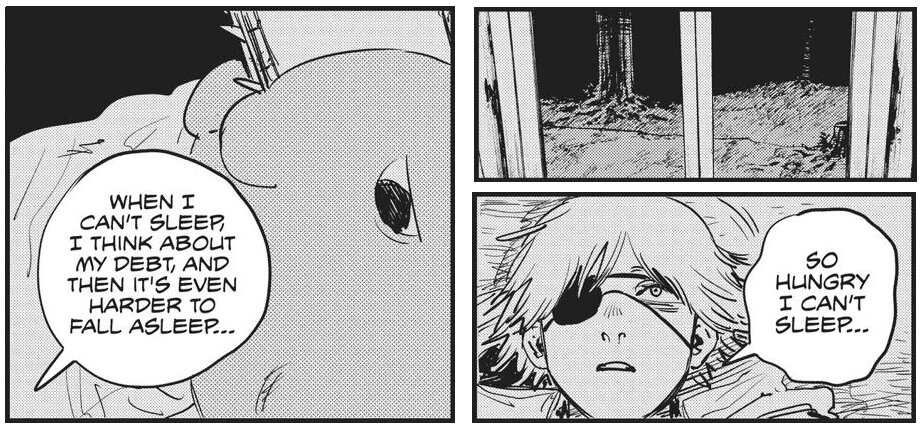
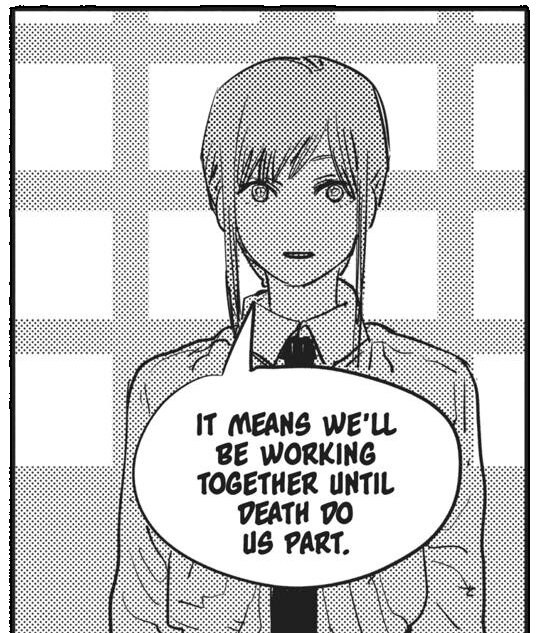
Most notably, when Makima swoops in and supplants his former debtors as his master, he doesn't even question her also calling him a pet or dog; For Denji, the idea of being a fully autonomous human being has never been an option. Yet, he isn't that stupid, and when he realizes what's happening in the second chapter as Makima sends him out to prove himself, he is understandably wary and upset at being utilized once more.
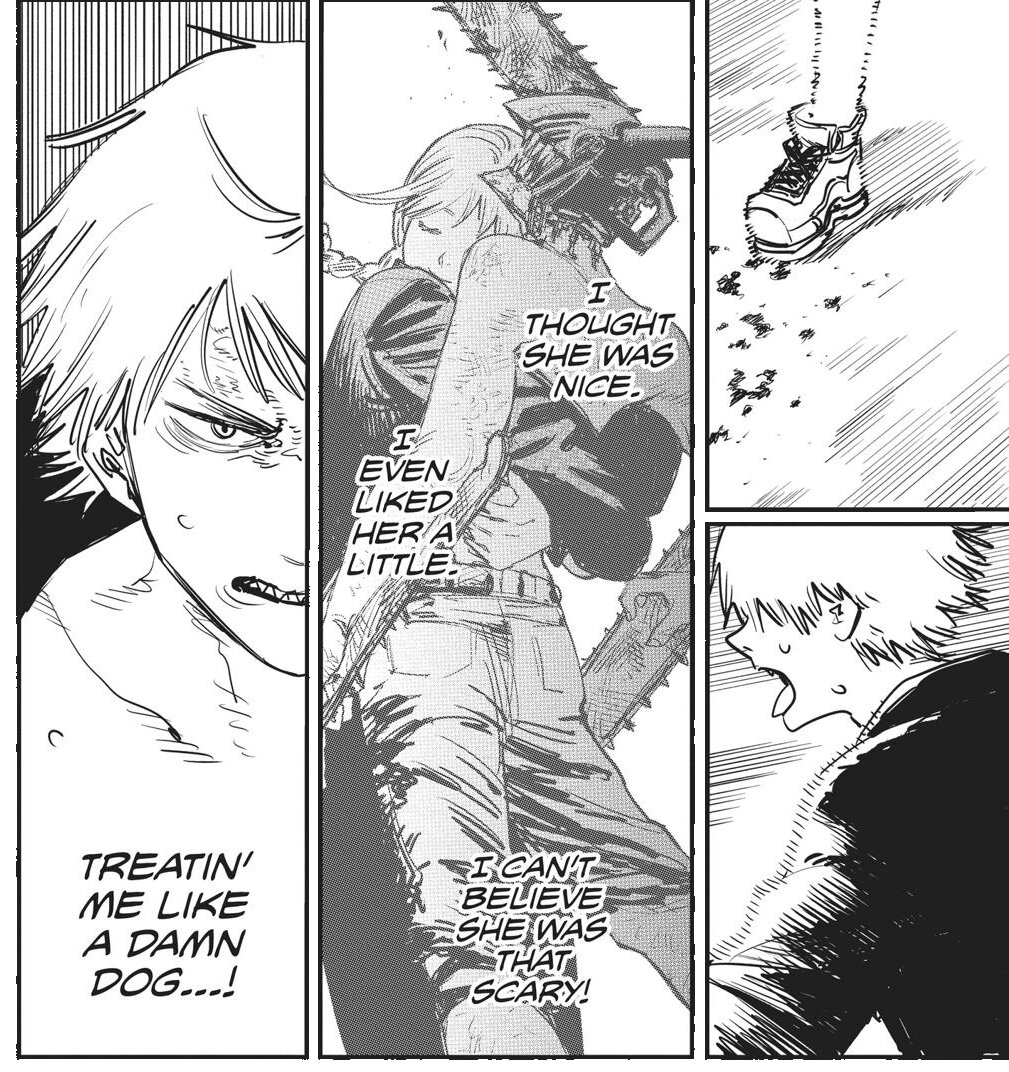
This scene is cut in the anime, and I really wish it wasn't.
Denji is cognizant of how his situation really hasn't changed, or might even be worse because of the high risk associated with any failure. He even makes plans to run away.
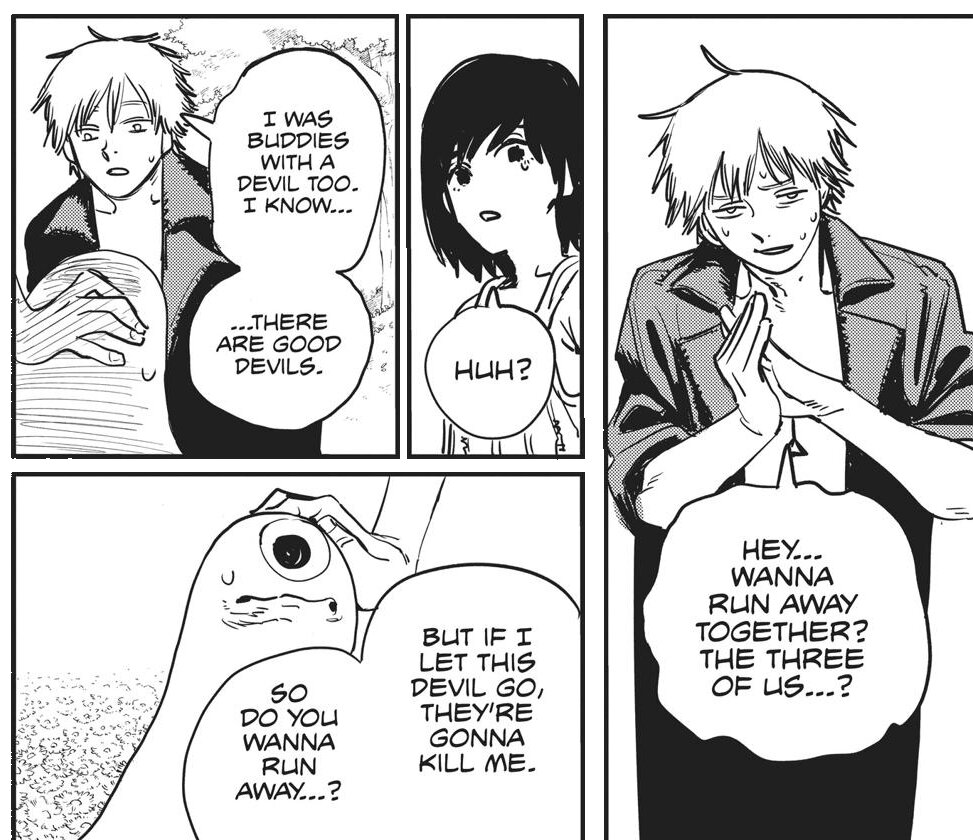
So what justifies it to him? The answer is twofold. First off, he comes to realize that, with Pochita's ripcord now hanging merged from his chest, that maybe he really is a dog and therefore deservant of that treatment. And secondly, that Denji's realistic caution is completely smothered by his infatuation with Makima, and the sense of emotional debt he and every other one of her "dogs" feel to her for "saving" them. With his only pre-existing happiness, Pochita, being inaccessible to him now, Makima's overwhelming kindness seems to soothe the grief and despair in Denji's heart with such gusto that he never stood a chance to resist.
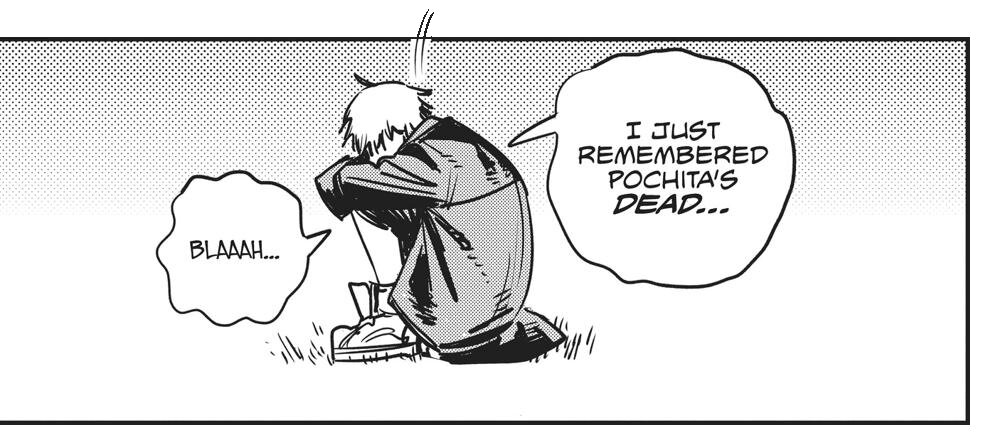
This framework of overtly feminine kindness allows Denji to be even further dehumanized because it is never portrayed as insidious or exploitative from his perspective past this initial point. Women have never been kind to him or even paid attention to him, so for the stars to align in this way (a manner that Makima very likely orchestrated, to some extent) provides an overwhelming sense of purpose and bliss to our protagonist and a will to live, whether or not he truly had a choice in wanting it.
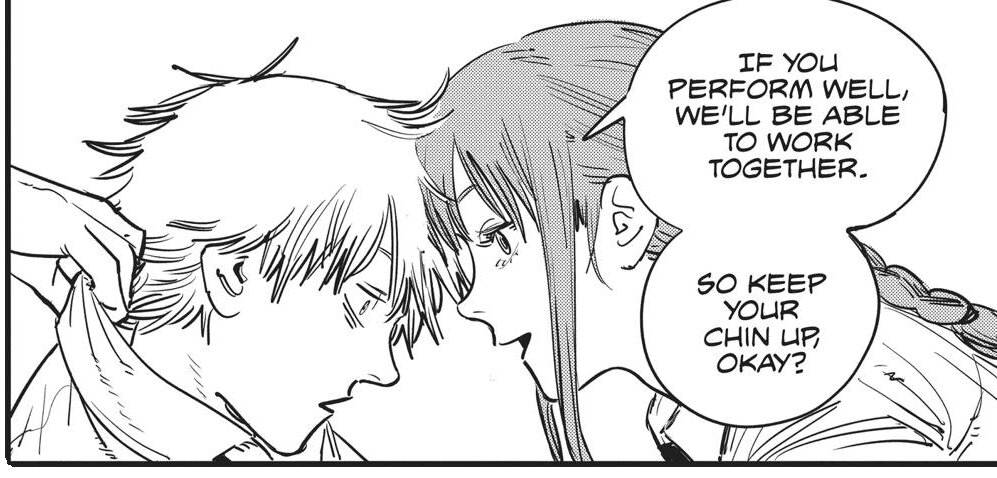
Keen readers might notice, though, that the calculated way in which Makima teases him along are empty promises; Throughout Chainsaw Man I was impressed by how subtly Fujimoto was able to make Denji's romanticized perspective appear to be objective because of how overwhelmingly dependent on others he is, perhaps leading many readers to believe that Denji's nigh-worship of Makima actually could've bore fruit. The truth is, Makima's manipulation of Denji is only a means to an end for her to subjugate Pochita, or as we later know him, Chainsaw Man.
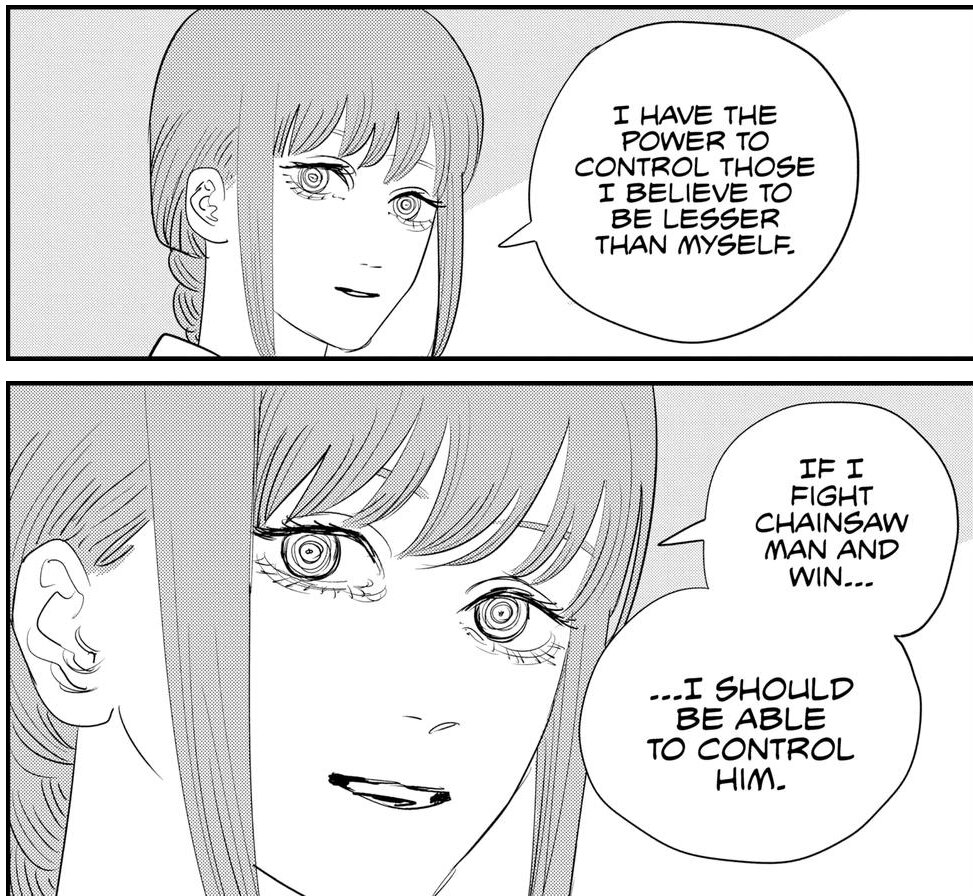
Denji, the human being, is so low on Makima's radar that she fails to even differentiate his smell from any other human in the end. I cannot stress this enough; Makima, as the Control Devil, is an ammoral figure. She deeply struggles to understand the roller coaster that is human emotions, so that which pulls on human heartstrings falls on her deaf ears. The manipulation of Denji, to her, was no different from playing a strategy game or clicker training a dog, and whatever consequences that befall the boy and we find abhorrent as other human beings mean nothing to her.
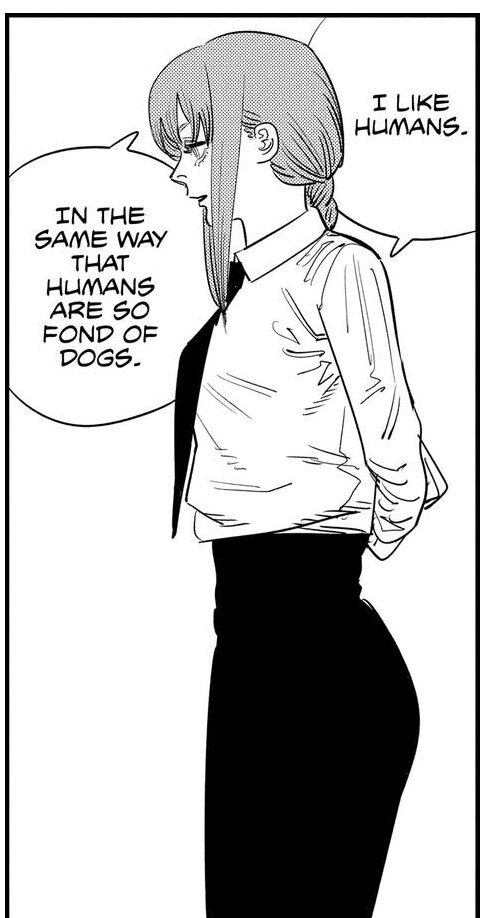
Here, I can understand the comparison to dominatrix work, although it isn't in the sense that Makima's fans would like; To act controlling and particularly use your feminine wiles to string someone along without having to exert yourself in any real capacity is the backbone of how to be successful in any sex work, or honestly the service sector overall. Makima, in a very non-arousing sense, is aware of her appearance as a woman, the ways someone with her appearance could seduce humans, and how to tie all of these things together with her inherent nature to conquer. Even when she gives Denji a "taste" of what he could have with her, it is always indirect- He is made to grope her through her uniform, he is given an indirect kiss via a Chupa Chups. It is absolutely integral that we realize that Denji's fantasies about Makima's body under her clothes and the touch of her skin is just that, a fantasy, set against the actual character who makes it very clear that she wants to exert herself as little as possible, and most notably can. Only then can one understand just how much true control she has as a woman.
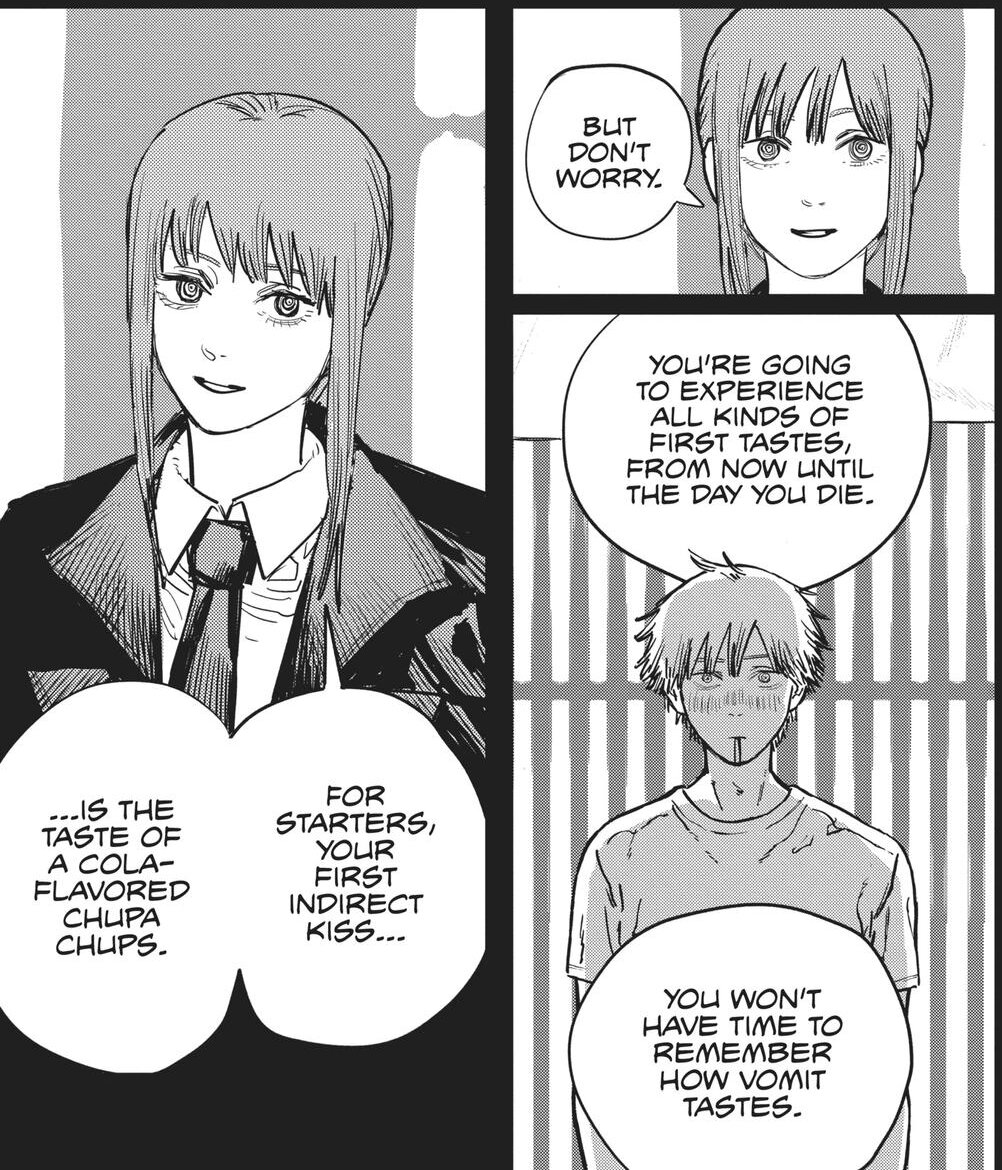
So what do we make of Makima's brief moments of loneliness, of geekhood? I mentioned earlier that she struggles to understand human emotions, but that isn't to say she wants to. We get to see her as a character who, I would argue, has been equally damaged as Denji, a "necessary evil" chained by the Japanese government and while fully cognizant of how inconsequential human bureaucracy is, she fails to realize that the social norms applied to her have molded her into a person with no chance to relate to others.
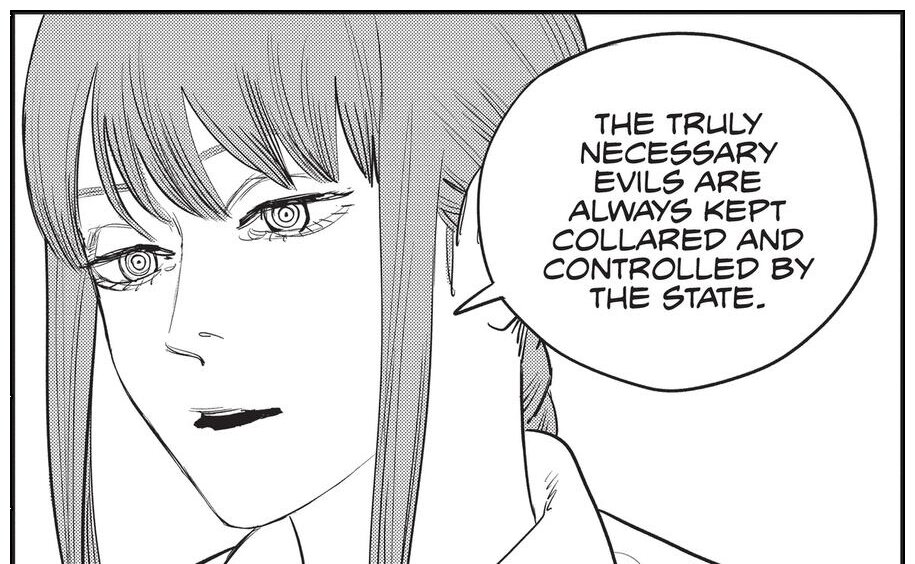
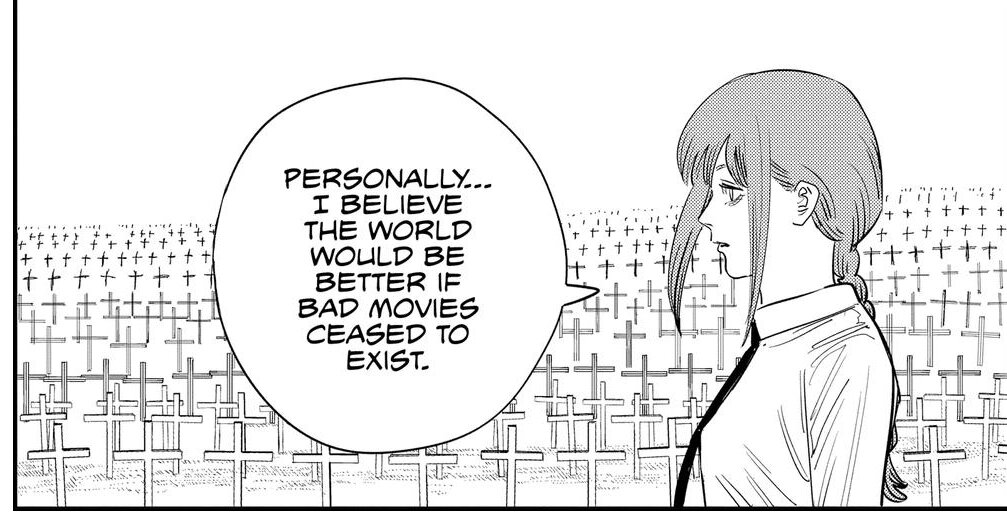
Makima in the meantime, on the journey to that point, is so full of self-loathing that the only way she can force herself to even feel a sliver of human emotions is to look for films that punch her in the gut. One could argue that she only brought Denji along on the date to further tease him, or to hear Chainsaw Man's heart beating when she laid against his chest.
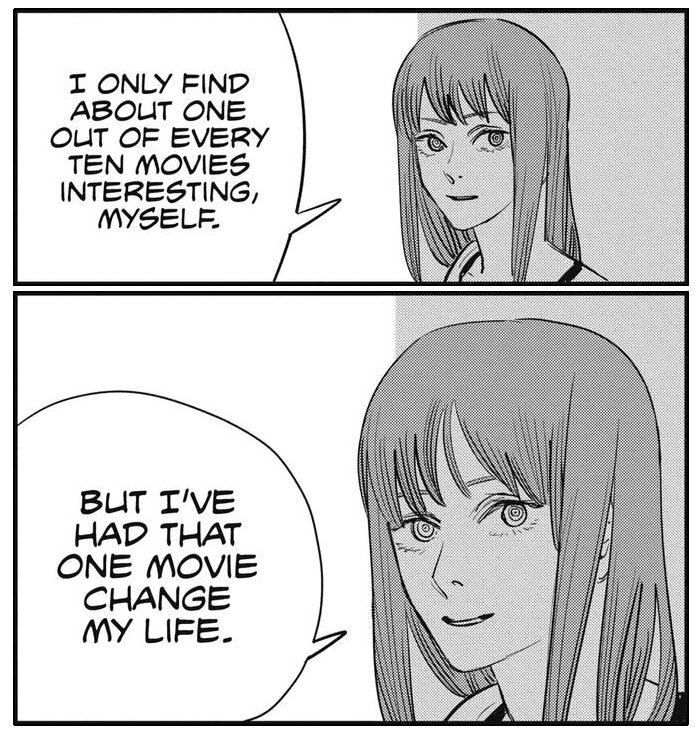
However, if you ask me, I would say that, in addition to those things, she brought Denji along to gauge whether or not her reactions could be compared to an actual human being. Her discussion of the films throughout with Denji are her only attempt to communicate with a human on a peer level, and she is satisfied with how both of their emotional responses to the films coincided by chance.
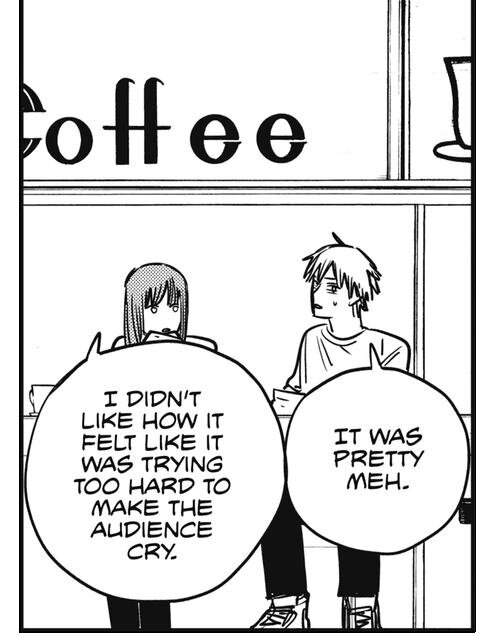
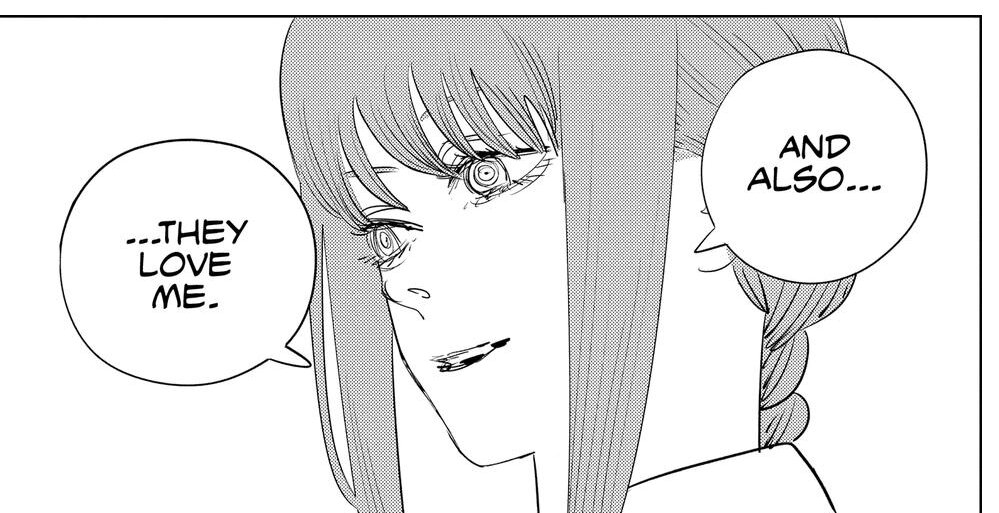
This makes it all the more tragic, then, when Denji inquires about if her perfect world will have bad movies, and she sees no use for them. We see here the key "failing" of Makima's roleplay of humanity, wherein while Denji can once again appreciate the journey to get to a satisfying end with both the good and the bad, Makima sees goals as the absolute, and nothing less than absolute is worth any time to her. But when you're the only absolute being in existence, you get pretty damn lonely.
I'd also like to make mention of how Makima wasn't necessarily born this way, at least if Nayuta is any indication of the nature vs. nurture pathways. The Japanese government has provided Makima with a framework that she herself accepts, steering even the embodiment of control with the prime minister contract that sends all damage done unto her unto others. I wish more people talked about this, because what Makima can represent in this moment is the unfulfillment that capitalism places upon people of all sectors besides the absolute top, even on a person who believes themselves to be fully in control. There is a deep tragedy to Makima's character in how she sought to control something she fundamentally does not understand, and in a way, this hubris is deeply human, regardless of gender. Similarly to Reze's grooming as a human weapon, Makima too has been groomed as a tool herself, and her struggle to self-actualize with human emotions is all we get to see of a person who unfortunately only knows how to perpetuate the cycle of abuse once more as the means to get what she wants most.
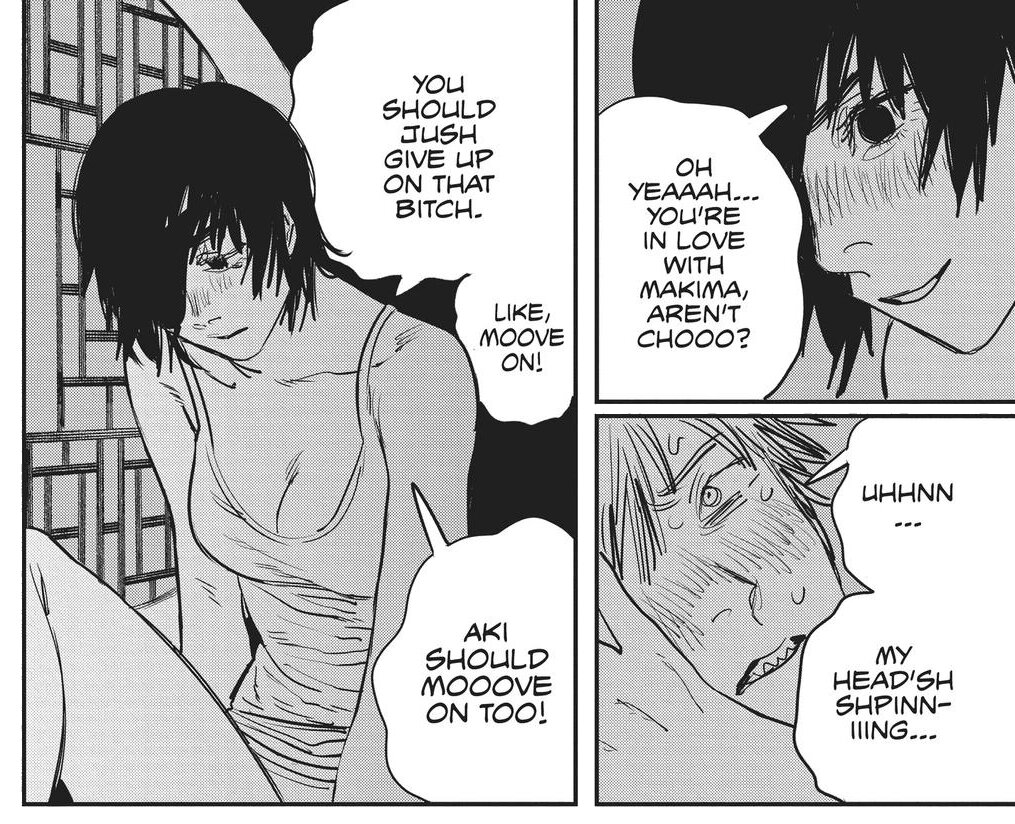
Speaking of Reze, I think it's very interesting that only her and Himeno are those who critique Makima before the climax of Chainsaw Man. These women also romantically and sexually exploit Denji, often times in a manner that superficially seems like a sleezy jealousy plotline. In actuality, they are aware of the universe and culture of abuse facilitated by Makima, and that what they do to the boy is nothing compared to the evil that that “bitch” or “witch” is inflicting on his psyche.
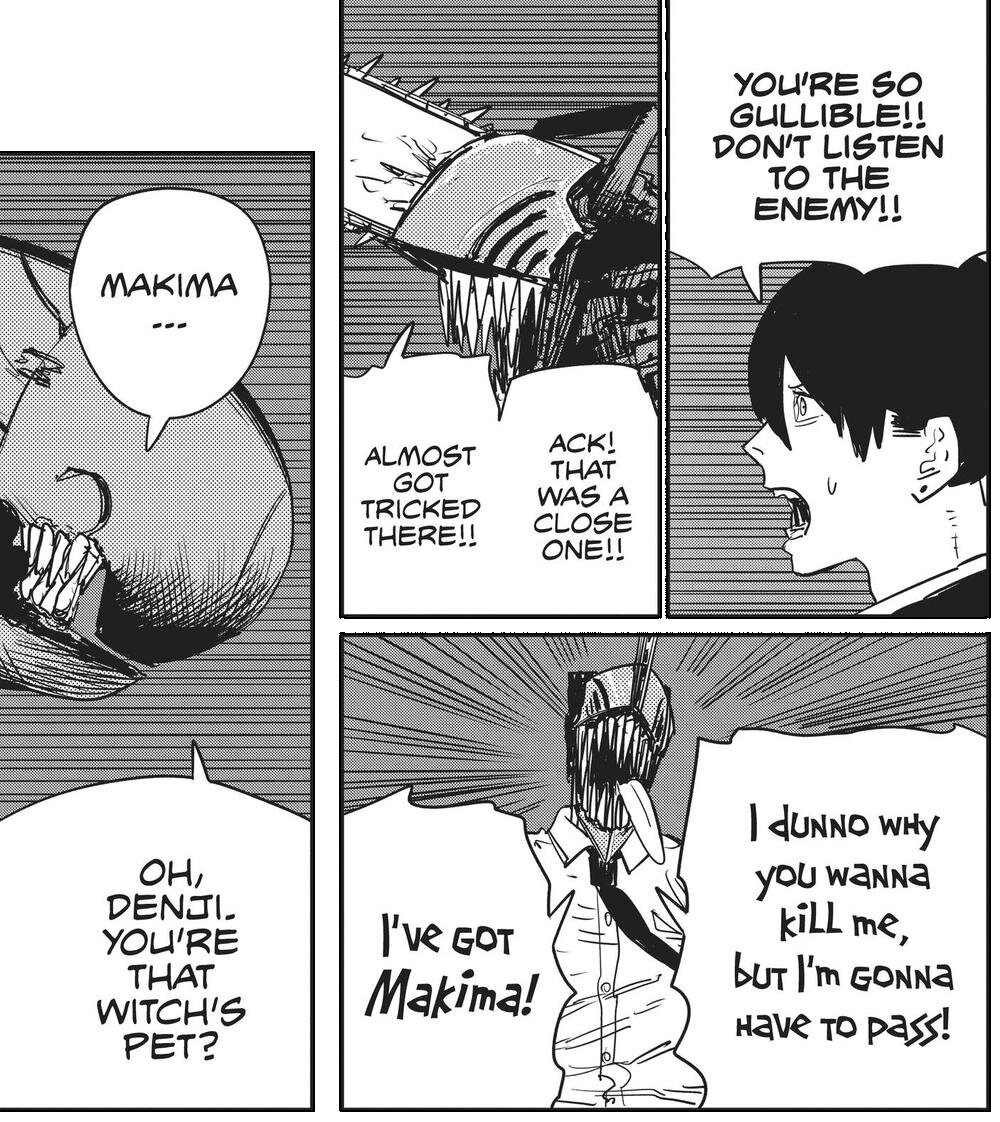
Most notably, we are never told that Makima's truest desire is to love and be loved without fear and hierarchy; this is simply Pochita's musings.
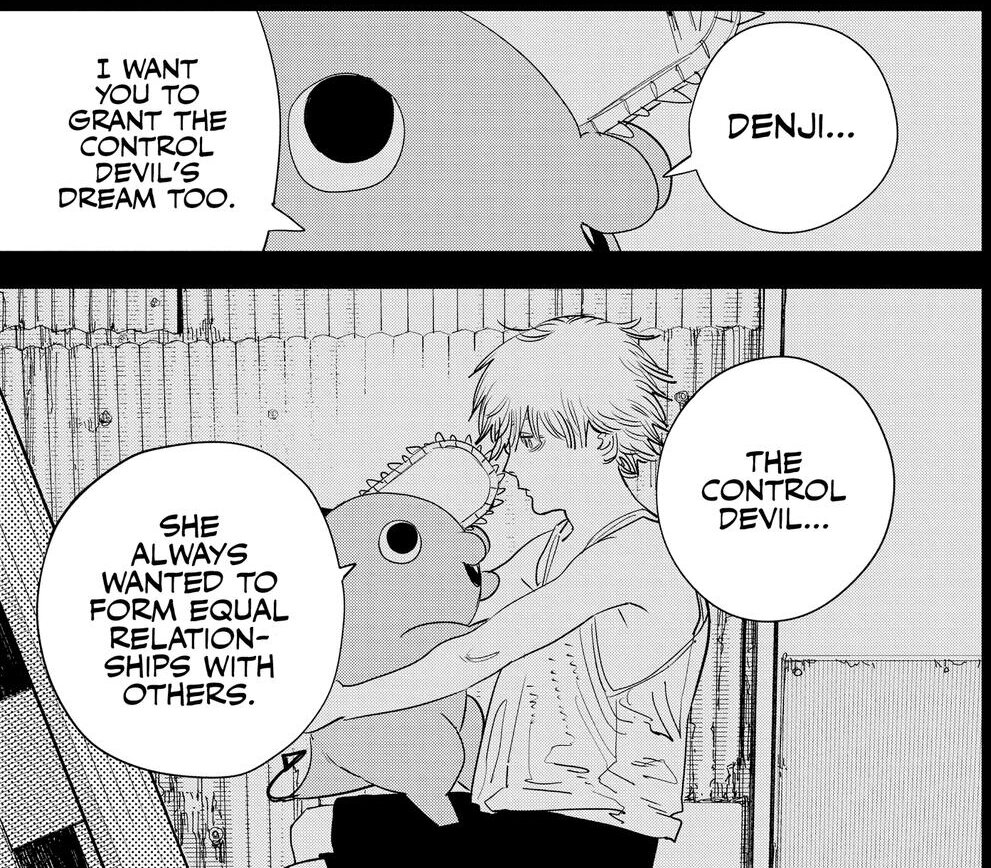
It is important to be aware of this, no matter how omnipotent Pochita truly is, because it literally-speaking strips Makima of her most intimate, well-guarded agency. This is, however, refuted by her explicit, spoken desire to be consumed by Chainsaw Man, which is respected in the end.
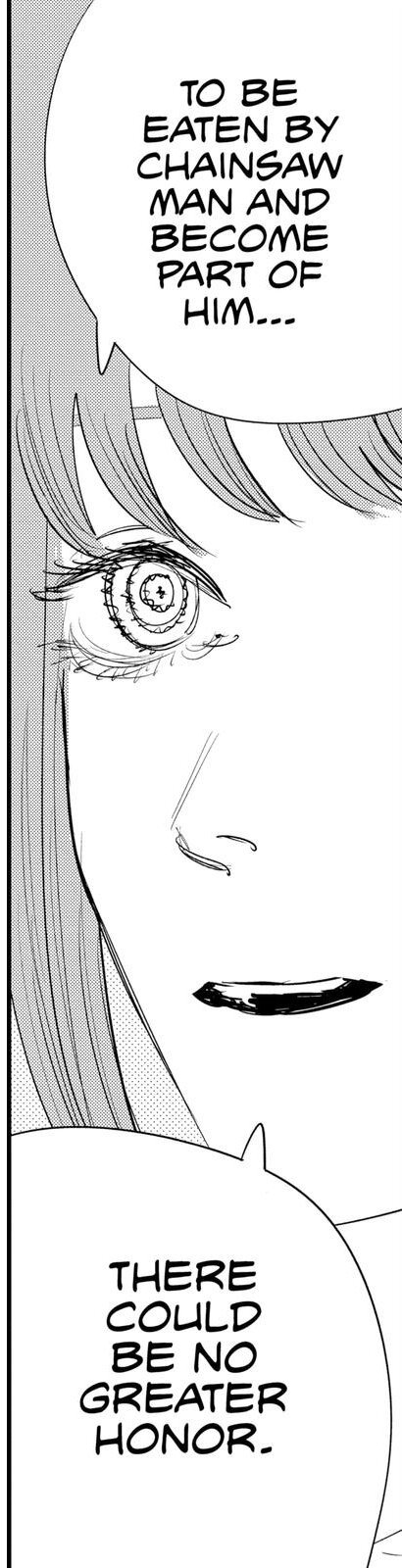
This desire is felt so strongly for her that she momentarily doubts her power of seductive control and her body, an insecurity that might not have come to light if Chainsaw Man was under her control. I would argue, however, she wins out in the end; Pochita, by contract, is subservient to Denji's dreams. And... Denji's dreams are still Makima.
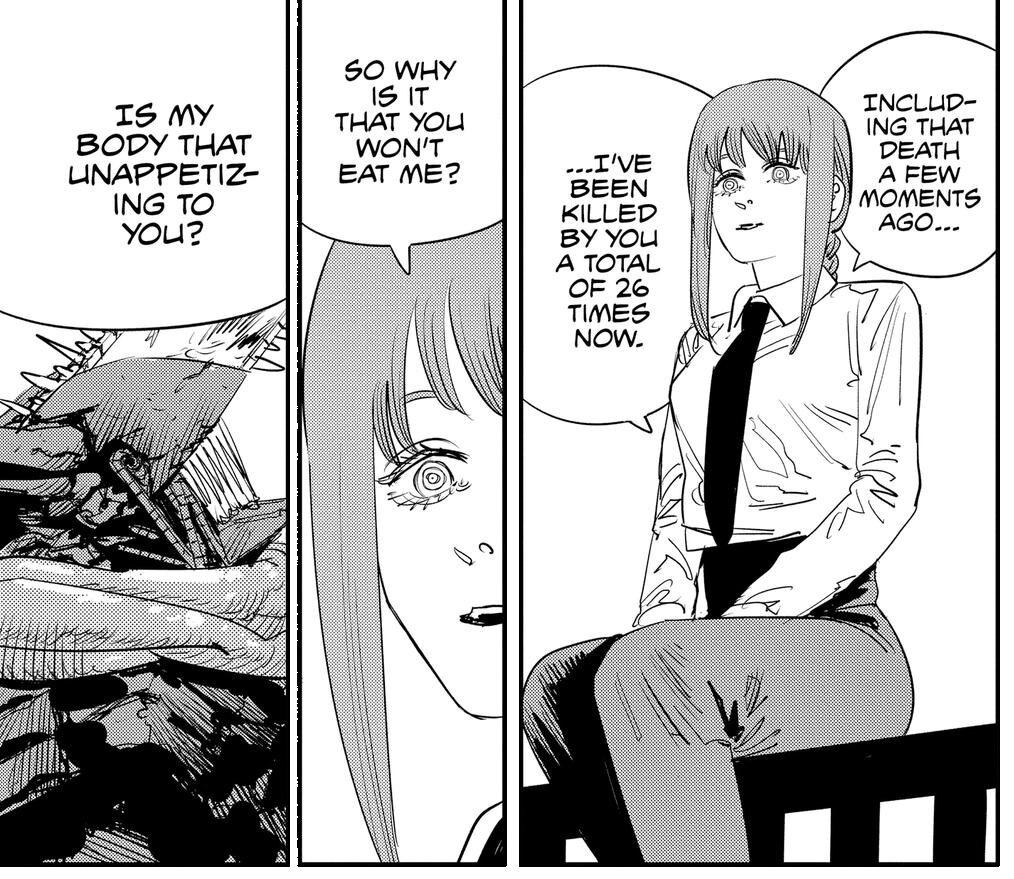
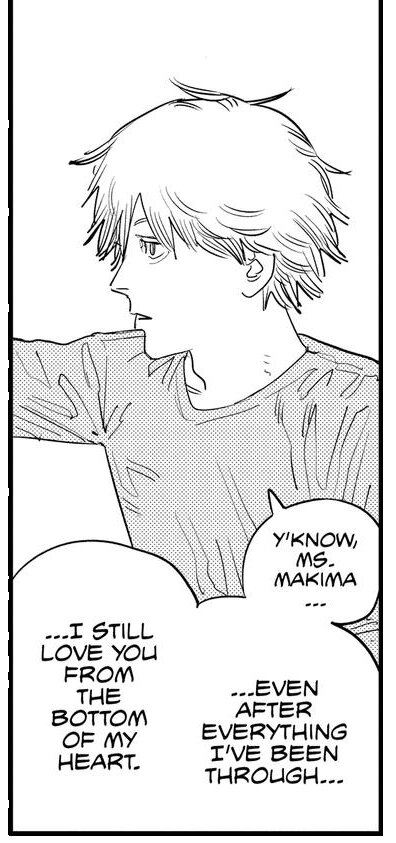
What makes this a hard-won, bittersweet victory for Makima is that consumption by the Chainsaw Devil is not in-line with the goal of getting close to people in an egalitarian way. Denji himself comments that he still loves Makima, but cannot forgive her for what she's done, thus justifying her horrific death in the eyes of most readers.
Makima's death by dismemberment and male consumption is reminiscent of Junji Itō's Tomie, wherein many comparisons can be drawn between these two characters. The titular Tomie is a woman who, through her inhuman beguilement, charms all of the men around her into irrational infatuation, and subsequently leaves the other women to feel resentful or suspicious. Tosha Taylor, in an essay entitled "Gendered Violence and the Abject Body in Junji Itō’s Tomie", describes this character as, "simultaneously [embodying] patriarchal fears of the domineering woman and feminine-coded fears of assault. Grotesque physical transformations throughout the manga render Tomie an abject monster while also revealing the terror of losing bodily autonomy". These two disparate characterizations make for a complex female figure who cannot be easily summarized into good or bad, victim or abuser, prey or predator.
Because Tomie is constantly portrayed as vain, haughty, and outwardly confident in her inherent abilities, the male perspective of each chapter seems to ultimately paint her as antagonistic; even moreso when the hero of a given story is one of the resentful, "not like other girls" women who can never get along with Tomie. Makima, similarly, is completely confident in her ability to subjugate others, but because she is characterized by her inhuman serenity and subtle manipulation of the emotions of men around her, she almost "gets away with it" because her antagonism is quiet and seemingly non-threatening.
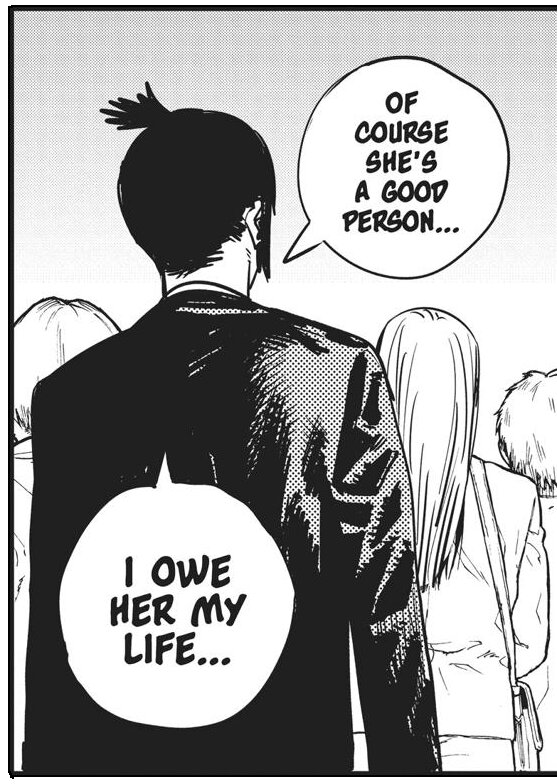
Furthermore, Makima has the added characteristic of being the "savior" of sorts for her vulnerable subordinates, who rather than postulate about whether or not she has ulterior motives for turning them into tools for her own goals, simply keep buying into the idea that shes a good person because 1. She saved their lives so how bad can she really be, and 2. The alternative, that she is evil or exploitative, means that they would have to start from rock bottom all over again. We see this most prominently with Aki, an otherwise intelligent and deductive character, who is foiled time and time again by his desperation to get closure and normalcy, in how he introduces Makima as a "good" person because she "saved" his life. By the end of Chainsaw Man, he has made a contract with her as a devil in a last-ditch effort to achieve his life goal, painting him as particularly tragic because not only does he become what he hated most, it is all in service of Makima's higher goal to subjugate Chainsaw Man.
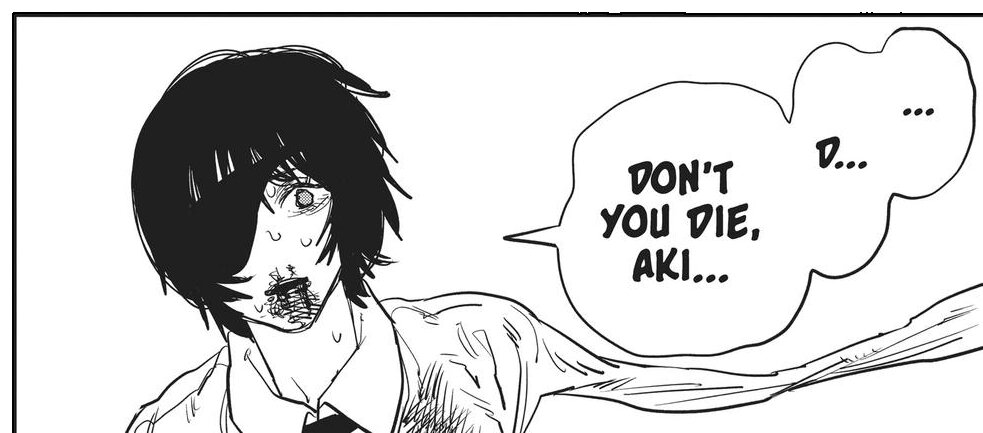
Even the women who "oppose" Makima can only do so when it is in relation to her treatment of the men they care for. Himeno, to Aki, is the woman who suggests that he leave the public sector, having enough cognizance to realize that it will do them both in given enough time spent in the field. The letters her sister kept hint at her own desperation, and compared to the way that Makima's motives are almost always commented on from the outside, Himeno's own voice and criticism of Makima's utilitarianism paints her as a much more sympathetic character. She dies urging Aki to self-determine for once, instead of the Control Devil.
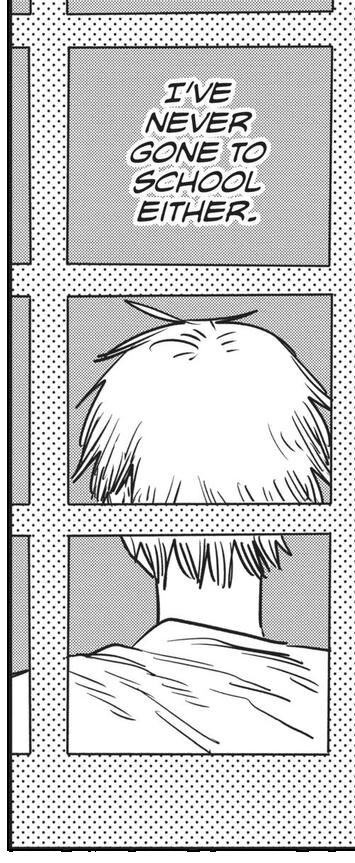
Similarly, Reze's urging of Denji to abandon the public sector and run away with her is initially portrayed as a self-admitted tactic to manipulate Denji's heart to destroy him for the Soviet government's purposes. But, in her final moments, dying at the hands of Makima, she realizes how she too is simply a pawn in the plans of these bigger powers, and that she herself was denied the simple human experience of going to school like Denji.
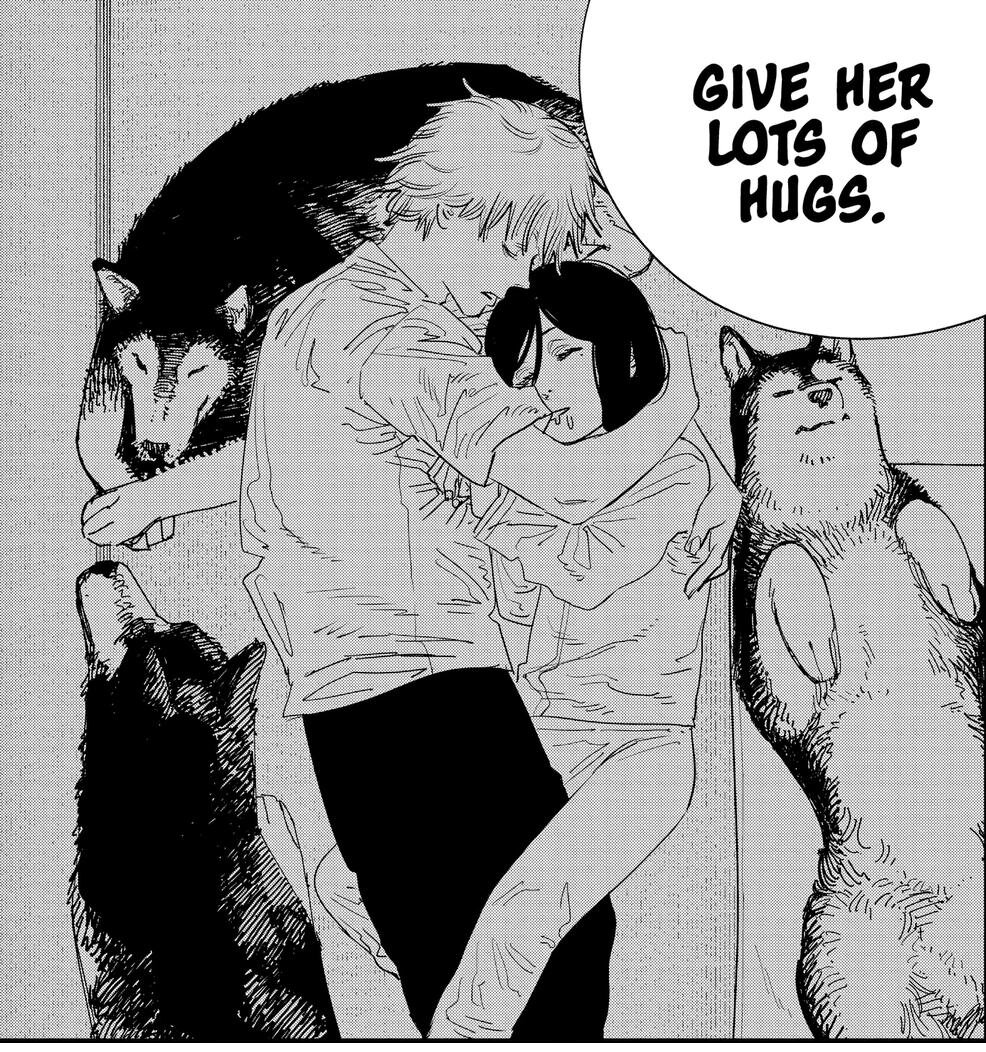
These women- complicated and essay-worthy in their own right- express a deep resignation and hopelessness that, because of their comparative virtuousness explicitly towards the male protagonists, end up fueling the fire of and the audiences ultimate feeling of satisfaction at Makima's demise, whether or not they realize it. The comparison to Tomie can also be drawn with Nayuta's death by beheading and subsequent presentation as a meal; any attempt for this immortal being to rein in her bossy, controlling nature is stifled before she even has a chance to prove herself in any significant way, even her own bodily autonomy severed at the neck and served on a platter for Denji to consume and ultimately develop as a character from. Both Tomie and the Control Devil, in this sense, exist in a special kind of hell wherein their self-determination, even when it potentially could be noble, is brutally taken apart and redistributed not just when its threatening to the protagonist, but just as though it is inherent to their (feminine) existence.
In the same way that Tomie and the Control Devil could be understood as ammoral in their nonhuman actions, so too is this inherent facet portrayed as ammoral within the given manga's world; However, I do not think the audience is that stupid. We, as humans, understand these characters as women, and are urged (both explictly and implicitly) to feel that their actions are immoral by very human, misogynistic standards, thus justifying their punishing death not as forces of nature, but as women who got too "uppity".
This is why I feel that Makima is both subversive of these tropes, but also not exempt from them by any means. It's particularly frustrating that both her and Nayuta are given so little time to explain themselves, but in your standard shounen manga, no time wouldve been given at all for a woman to share her messy thoughts. Ultimately, I'd like to be optimistic that, because the overall fan reception of Makima's character has been positive, it will encourage others to look at this somewhat mainstream portrayal of a woman with power and postulate on how such a character can be improved upon from a feminist context; portrayed as someone that isn't punished for her feminine "hubris", isn't ultimately a complete villain, and can express herself in her own words.
CW: discussions of grooming, misogyny, sexual violence, & sex work.
I’ve been aware of Chainsaw Man since 2018, when the manga first started to gain traction with a few friends of mine. It took me until May of 2025 to read it in-full up to its current chapter though, and my reasoning is about as flimsy as any other; I'm a femdom, and I was told that this story has a femdom. So I read it, and felt a bit of confusion. Makima is certainly the "femdom" in question, but that's such a flattening of her character into a single sexual fantasy; It does a disservice to femdoms who ensure their subs are treated with respect and trust, does a disservice to victims of groomers who act like her under the guise of "femdom", does a disservice to feminists looking at the ways women in power are written and treated, and most of all... is pretty fucking boring.
So while she is easily my favorite and one of the most interesting characters I’ve come across in a while, I found myself saddened but not surprised at the lack of analysis of her character and Chainsaw Man overall. Particularly, those that came from the standpoint of comparative literature, and how few wanted to tease out how her writing can have strengths that improve upon this heavily misogynistic genre's norm while also reinforcing the shallow tropes with much precedent before it. In my typical autistic sense, that which her writing is missing drives me to understand thoroughly why and how. I'd really like to investigate and provide a bit of perspective on the strengths and weaknesses of Makima’s portrayal as a powerful woman, in all of it's mixed subversion and reinforcement.
We can see the difference of how power is utilized and perceived in the world of Chainsaw Man from the very first chapter, when comparing Denji's loyal repayment of the debt contract under the yakuza vs. his public service under Makima. Both situations give Denji no choice in the matter, exploiting his meager existence to the absolute brink, and with the yakuza, he can't help but feel the dread and hopelessness of living because of the mental and physical impact it has on him.
Most notably, when Makima swoops in and supplants his former debtors as his master, he doesn't even question her also calling him a pet or dog; For Denji, the idea of being a fully autonomous human being has never been an option. Yet, he isn't that stupid, and when he realizes what's happening in the second chapter as Makima sends him out to prove himself, he is understandably wary and upset at being utilized once more.
This scene is cut in the anime, and I really wish it wasn't.
Denji is cognizant of how his situation really hasn't changed, or might even be worse because of the high risk associated with any failure. He even makes plans to run away.
So what justifies it to him? The answer is twofold. First off, he comes to realize that, with Pochita's ripcord now hanging merged from his chest, that maybe he really is a dog and therefore deservant of that treatment. And secondly, that Denji's realistic caution is completely smothered by his infatuation with Makima, and the sense of emotional debt he and every other one of her "dogs" feel to her for "saving" them. With his only pre-existing happiness, Pochita, being inaccessible to him now, Makima's overwhelming kindness seems to soothe the grief and despair in Denji's heart with such gusto that he never stood a chance to resist.
This framework of overtly feminine kindness allows Denji to be even further dehumanized because it is never portrayed as insidious or exploitative from his perspective past this initial point. Women have never been kind to him or even paid attention to him, so for the stars to align in this way (a manner that Makima very likely orchestrated, to some extent) provides an overwhelming sense of purpose and bliss to our protagonist and a will to live, whether or not he truly had a choice in wanting it.
Keen readers might notice, though, that the calculated way in which Makima teases him along are empty promises; Throughout Chainsaw Man I was impressed by how subtly Fujimoto was able to make Denji's romanticized perspective appear to be objective because of how overwhelmingly dependent on others he is, perhaps leading many readers to believe that Denji's nigh-worship of Makima actually could've bore fruit. The truth is, Makima's manipulation of Denji is only a means to an end for her to subjugate Pochita, or as we later know him, Chainsaw Man.
Denji, the human being, is so low on Makima's radar that she fails to even differentiate his smell from any other human in the end. I cannot stress this enough; Makima, as the Control Devil, is an ammoral figure. She deeply struggles to understand the roller coaster that is human emotions, so that which pulls on human heartstrings falls on her deaf ears. The manipulation of Denji, to her, was no different from playing a strategy game or clicker training a dog, and whatever consequences that befall the boy and we find abhorrent as other human beings mean nothing to her.
Here, I can understand the comparison to dominatrix work, although it isn't in the sense that Makima's fans would like; To act controlling and particularly use your feminine wiles to string someone along without having to exert yourself in any real capacity is the backbone of how to be successful in any sex work, or honestly the service sector overall. Makima, in a very non-arousing sense, is aware of her appearance as a woman, the ways someone with her appearance could seduce humans, and how to tie all of these things together with her inherent nature to conquer. Even when she gives Denji a "taste" of what he could have with her, it is always indirect- He is made to grope her through her uniform, he is given an indirect kiss via a Chupa Chups. It is absolutely integral that we realize that Denji's fantasies about Makima's body under her clothes and the touch of her skin is just that, a fantasy, set against the actual character who makes it very clear that she wants to exert herself as little as possible, and most notably can. Only then can one understand just how much true control she has as a woman.
So what do we make of Makima's brief moments of loneliness, of geekhood? I mentioned earlier that she struggles to understand human emotions, but that isn't to say she wants to. We get to see her as a character who, I would argue, has been equally damaged as Denji, a "necessary evil" chained by the Japanese government and while fully cognizant of how inconsequential human bureaucracy is, she fails to realize that the social norms applied to her have molded her into a person with no chance to relate to others.
Makima in the meantime, on the journey to that point, is so full of self-loathing that the only way she can force herself to even feel a sliver of human emotions is to look for films that punch her in the gut. One could argue that she only brought Denji along on the date to further tease him, or to hear Chainsaw Man's heart beating when she laid against his chest.
However, if you ask me, I would say that, in addition to those things, she brought Denji along to gauge whether or not her reactions could be compared to an actual human being. Her discussion of the films throughout with Denji are her only attempt to communicate with a human on a peer level, and she is satisfied with how both of their emotional responses to the films coincided by chance.
This makes it all the more tragic, then, when Denji inquires about if her perfect world will have bad movies, and she sees no use for them. We see here the key "failing" of Makima's roleplay of humanity, wherein while Denji can once again appreciate the journey to get to a satisfying end with both the good and the bad, Makima sees goals as the absolute, and nothing less than absolute is worth any time to her. But when you're the only absolute being in existence, you get pretty damn lonely.
I'd also like to make mention of how Makima wasn't necessarily born this way, at least if Nayuta is any indication of the nature vs. nurture pathways. The Japanese government has provided Makima with a framework that she herself accepts, steering even the embodiment of control with the prime minister contract that sends all damage done unto her unto others. I wish more people talked about this, because what Makima can represent in this moment is the unfulfillment that capitalism places upon people of all sectors besides the absolute top, even on a person who believes themselves to be fully in control. There is a deep tragedy to Makima's character in how she sought to control something she fundamentally does not understand, and in a way, this hubris is deeply human, regardless of gender. Similarly to Reze's grooming as a human weapon, Makima too has been groomed as a tool herself, and her struggle to self-actualize with human emotions is all we get to see of a person who unfortunately only knows how to perpetuate the cycle of abuse once more as the means to get what she wants most.
Speaking of Reze, I think it's very interesting that only her and Himeno are those who critique Makima before the climax of Chainsaw Man. These women also romantically and sexually exploit Denji, often times in a manner that superficially seems like a sleezy jealousy plotline. In actuality, they are aware of the universe and culture of abuse facilitated by Makima, and that what they do to the boy is nothing compared to the evil that that “bitch” or “witch” is inflicting on his psyche.
Most notably, we are never told that Makima's truest desire is to love and be loved without fear and hierarchy; this is simply Pochita's musings.
It is important to be aware of this, no matter how omnipotent Pochita truly is, because it literally-speaking strips Makima of her most intimate, well-guarded agency. This is, however, refuted by her explicit, spoken desire to be consumed by Chainsaw Man, which is respected in the end.
This desire is felt so strongly for her that she momentarily doubts her power of seductive control and her body, an insecurity that might not have come to light if Chainsaw Man was under her control. I would argue, however, she wins out in the end; Pochita, by contract, is subservient to Denji's dreams. And... Denji's dreams are still Makima.
What makes this a hard-won, bittersweet victory for Makima is that consumption by the Chainsaw Devil is not in-line with the goal of getting close to people in an egalitarian way. Denji himself comments that he still loves Makima, but cannot forgive her for what she's done, thus justifying her horrific death in the eyes of most readers.
Makima's death by dismemberment and male consumption is reminiscent of Junji Itō's Tomie, wherein many comparisons can be drawn between these two characters. The titular Tomie is a woman who, through her inhuman beguilement, charms all of the men around her into irrational infatuation, and subsequently leaves the other women to feel resentful or suspicious. Tosha Taylor, in an essay entitled "Gendered Violence and the Abject Body in Junji Itō’s Tomie", describes this character as, "simultaneously [embodying] patriarchal fears of the domineering woman and feminine-coded fears of assault. Grotesque physical transformations throughout the manga render Tomie an abject monster while also revealing the terror of losing bodily autonomy". These two disparate characterizations make for a complex female figure who cannot be easily summarized into good or bad, victim or abuser, prey or predator.
Because Tomie is constantly portrayed as vain, haughty, and outwardly confident in her inherent abilities, the male perspective of each chapter seems to ultimately paint her as antagonistic; even moreso when the hero of a given story is one of the resentful, "not like other girls" women who can never get along with Tomie. Makima, similarly, is completely confident in her ability to subjugate others, but because she is characterized by her inhuman serenity and subtle manipulation of the emotions of men around her, she almost "gets away with it" because her antagonism is quiet and seemingly non-threatening.
Furthermore, Makima has the added characteristic of being the "savior" of sorts for her vulnerable subordinates, who rather than postulate about whether or not she has ulterior motives for turning them into tools for her own goals, simply keep buying into the idea that shes a good person because 1. She saved their lives so how bad can she really be, and 2. The alternative, that she is evil or exploitative, means that they would have to start from rock bottom all over again. We see this most prominently with Aki, an otherwise intelligent and deductive character, who is foiled time and time again by his desperation to get closure and normalcy, in how he introduces Makima as a "good" person because she "saved" his life. By the end of Chainsaw Man, he has made a contract with her as a devil in a last-ditch effort to achieve his life goal, painting him as particularly tragic because not only does he become what he hated most, it is all in service of Makima's higher goal to subjugate Chainsaw Man.
Even the women who "oppose" Makima can only do so when it is in relation to her treatment of the men they care for. Himeno, to Aki, is the woman who suggests that he leave the public sector, having enough cognizance to realize that it will do them both in given enough time spent in the field. The letters her sister kept hint at her own desperation, and compared to the way that Makima's motives are almost always commented on from the outside, Himeno's own voice and criticism of Makima's utilitarianism paints her as a much more sympathetic character. She dies urging Aki to self-determine for once, instead of the Control Devil.
Similarly, Reze's urging of Denji to abandon the public sector and run away with her is initially portrayed as a self-admitted tactic to manipulate Denji's heart to destroy him for the Soviet government's purposes. But, in her final moments, dying at the hands of Makima, she realizes how she too is simply a pawn in the plans of these bigger powers, and that she herself was denied the simple human experience of going to school like Denji.
These women- complicated and essay-worthy in their own right- express a deep resignation and hopelessness that, because of their comparative virtuousness explicitly towards the male protagonists, end up fueling the fire of and the audiences ultimate feeling of satisfaction at Makima's demise, whether or not they realize it. The comparison to Tomie can also be drawn with Nayuta's death by beheading and subsequent presentation as a meal; any attempt for this immortal being to rein in her bossy, controlling nature is stifled before she even has a chance to prove herself in any significant way, even her own bodily autonomy severed at the neck and served on a platter for Denji to consume and ultimately develop as a character from. Both Tomie and the Control Devil, in this sense, exist in a special kind of hell wherein their self-determination, even when it potentially could be noble, is brutally taken apart and redistributed not just when its threatening to the protagonist, but just as though it is inherent to their (feminine) existence.
In the same way that Tomie and the Control Devil could be understood as ammoral in their nonhuman actions, so too is this inherent facet portrayed as ammoral within the given manga's world; However, I do not think the audience is that stupid. We, as humans, understand these characters as women, and are urged (both explictly and implicitly) to feel that their actions are immoral by very human, misogynistic standards, thus justifying their punishing death not as forces of nature, but as women who got too "uppity".
This is why I feel that Makima is both subversive of these tropes, but also not exempt from them by any means. It's particularly frustrating that both her and Nayuta are given so little time to explain themselves, but in your standard shounen manga, no time wouldve been given at all for a woman to share her messy thoughts. Ultimately, I'd like to be optimistic that, because the overall fan reception of Makima's character has been positive, it will encourage others to look at this somewhat mainstream portrayal of a woman with power and postulate on how such a character can be improved upon from a feminist context; portrayed as someone that isn't punished for her feminine "hubris", isn't ultimately a complete villain, and can express herself in her own words.